

13 UK HR Compliance Deadlines Your SME Must Know for 2026
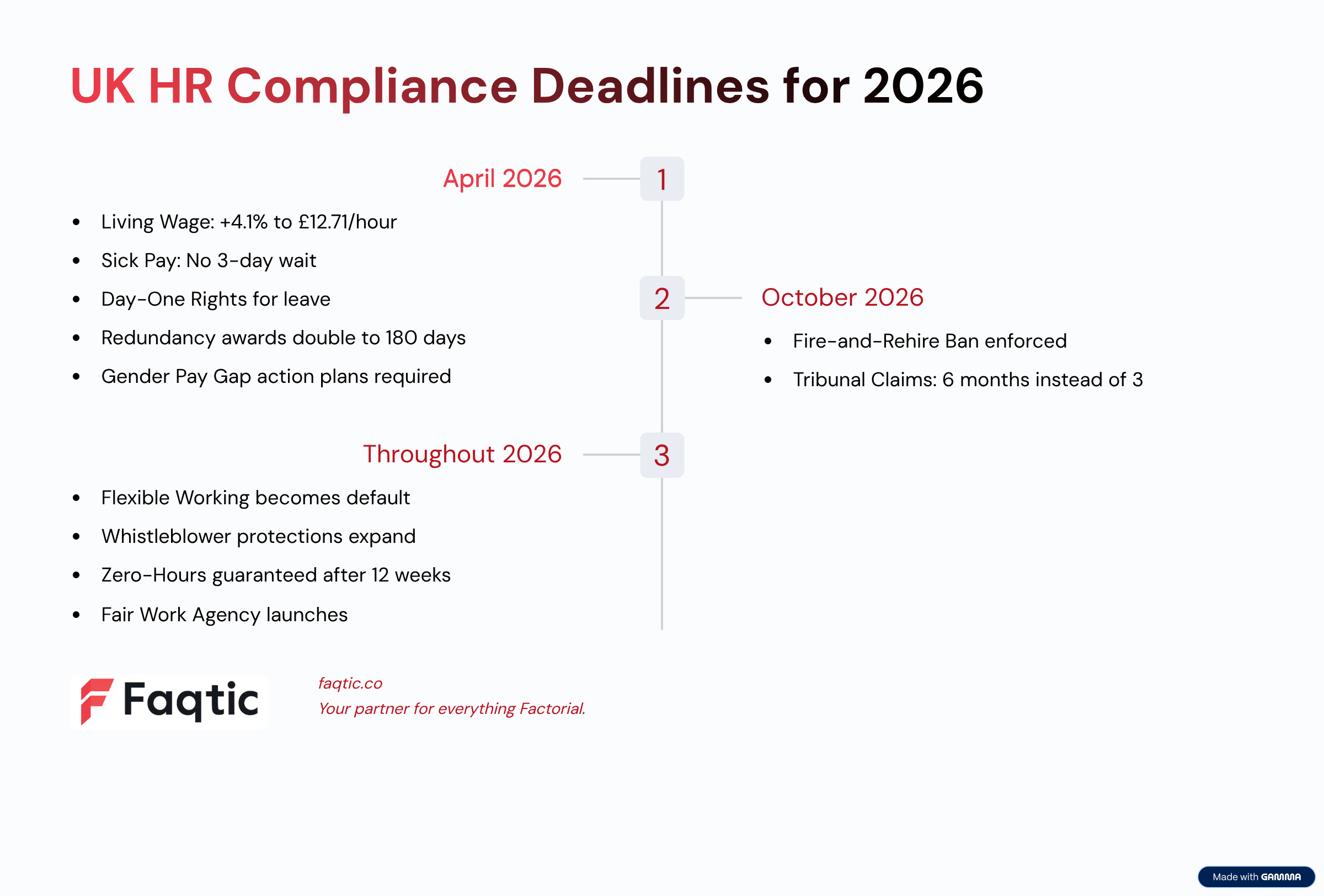
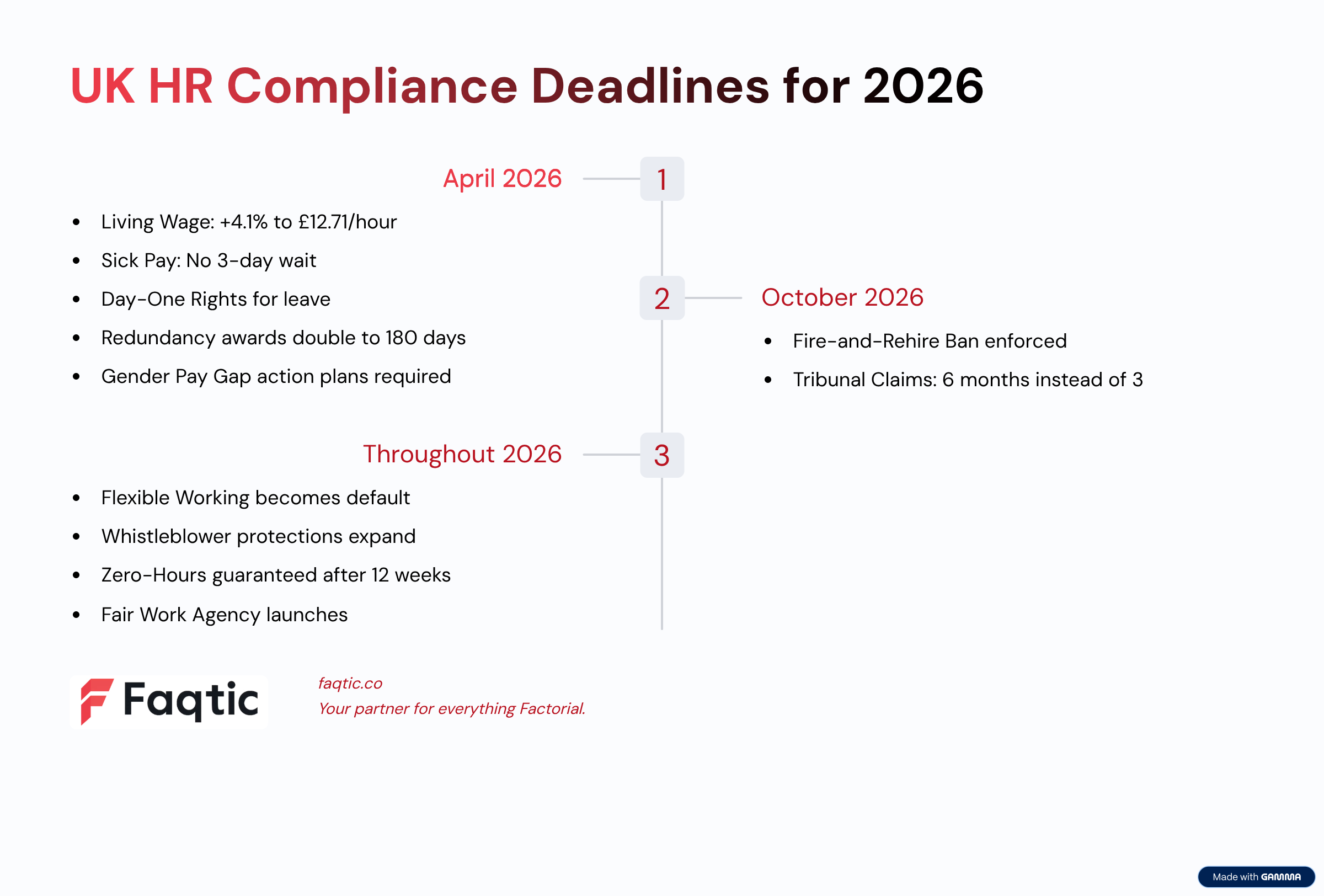
UK HR compliance changes in 2026 will reshape how every SME operates, with major employment law shifts requiring your immediate attention.
Marvin Molijn
CEO Faqtic.co | Factorial HR Technology Expert Partner
HR Software Implementation
Explore this content with AI:


UK HR compliance changes in 2026 will reshape how every SME operates, with major employment law shifts requiring your immediate attention.
Tribunal claims hit over 97,000 cases in 2024, making non-compliance costlier than ever before. April 2026 brings several critical employment law changes that directly affect your HR responsibilities. Statutory Sick Pay loses its three-day waiting period, adding an estimated £500 million in costs across UK businesses (roughly £15 per employee). Meanwhile, the new Fair Work Agency starts operations, equipped with stronger enforcement powers and closer oversight of your HR practices.
The Employment Rights Bill adds further complexity with its ban on fire-and-rehire practices (except during severe financial hardship), immediate rights to paternity and unpaid parental leave, and doubled maximum protective awards for poor redundancy consultation—now 180 days' pay per employee. Add the neonatal leave entitlement offering up to 12 weeks' paid leave for parents whose babies need specialist care, and small businesses face an intricate compliance landscape.
With these deadlines approaching fast, robust HR systems become essential rather than optional. Modern HR software like Factorial helps your business stay compliant with these changes while reducing administrative overhead.
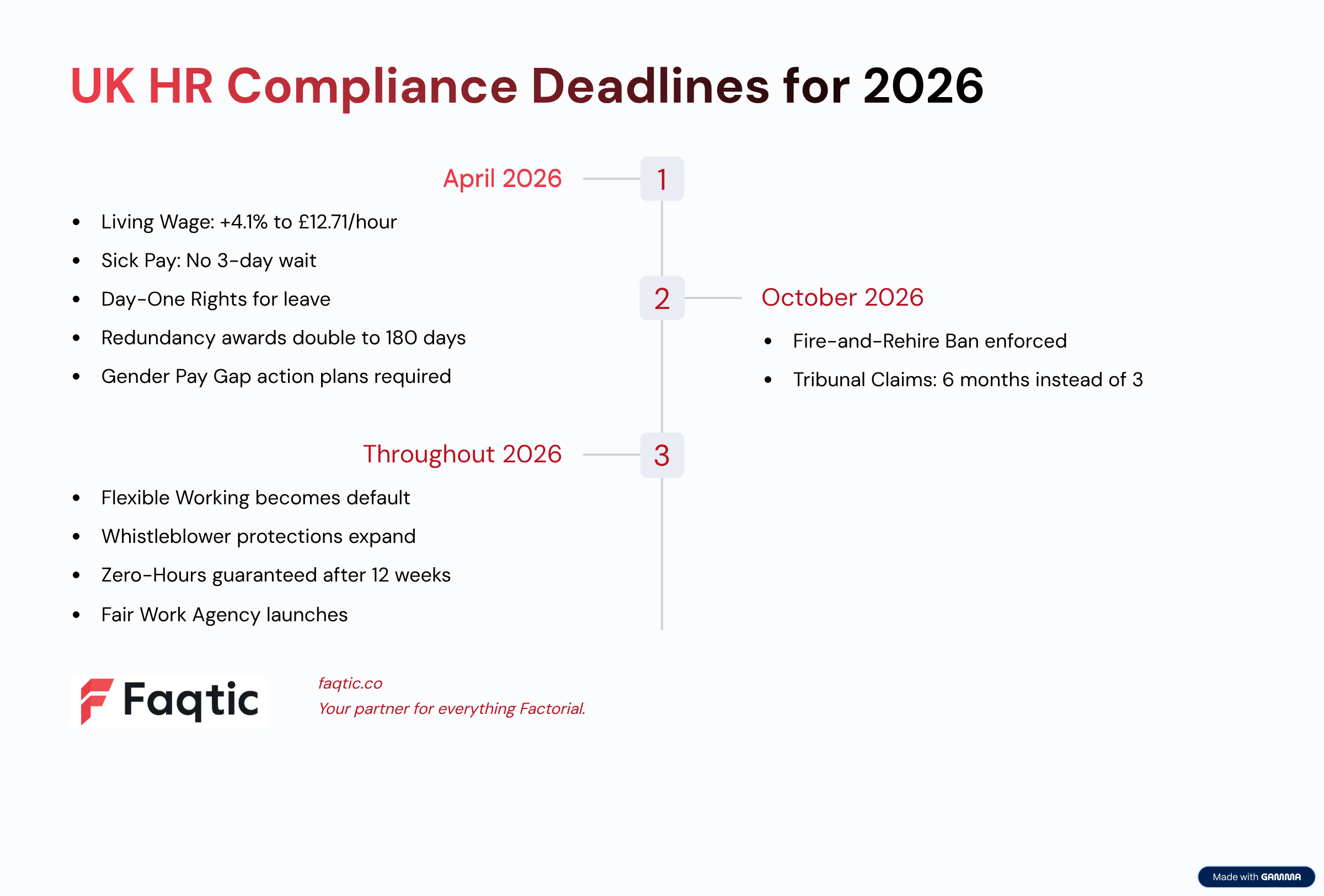
Image Source: Low Pay Commission - GOV.UK blogs
The National Living Wage jumps to £12.71 per hour from April 2026, marking a 4.1% increase from the current £12.21 rate. This continues the pattern of substantial wage rises for the UK's lowest-paid workers.
Minimum wage increase details for 2026
The projected increase reflects stronger wage growth and revised economic forecasts for 2025. The Low Pay Commission estimates a potential range between £12.55 and £12.86, depending on economic conditions. This maintains the government's commitment to keeping the National Living Wage at two-thirds of median earnings or above.
Recent 2025 increases show the scale of change:
-
Workers 21+ (National Living Wage): £12.21 (+6.7%)
-
Workers 18-20: £10.00 (+16.3%)
-
Workers 16-17 and apprentices: £7.55 (+18%)
A full-time worker on 37.5 hours weekly now earns approximately £23,800 annually, with further increases coming in 2026.
Impact of wage changes on SMEs
"Faqtic has been a great partner. Their support and responsiveness made the transition smooth and helped us get up and running quickly."
Jimmy Nguyen
CEO, Digital Recipe

These wage increases create significant pressure for small businesses already managing rising costs. Each full-time National Living Wage worker now costs over £1,500 more annually.
Business responses vary significantly:
-
23.9% plan to increase prices
-
17.6% will absorb costs within profit margins
-
6.8% expect to reduce staff numbers
Hospitality, retail, and cleaning sectors face the biggest impact, housing approximately 54% of minimum wage jobs. With profit margins averaging just 7.3% (manufacturing), 5.1% (retail), and 5.81% (hospitality), even small wage increases affect profitability substantially.
How Factorial helps manage payroll updates
Managing mandatory wage increases requires precise timing and calculation. Factorial's automated payroll updates adjust to new rates when they take effect—crucial since increases apply after the next 'pay reference period' rather than immediately.
The platform's budget forecasting tools model financial impact across departments, highlighting where wage costs will rise most. This enables proactive planning rather than reactive scrambling.
Factorial's compliance dashboard provides advance notifications of the April 2026 deadline, preventing HMRC penalties. Your HR team focuses on strategy while the system handles calculations and adjustments automatically.
Image Source: PAYadvice.UK
April 2026 brings major Statutory Sick Pay reforms that will reshape sickness absence management for UK SMEs. These changes form a cornerstone of the Employment Rights Bill, targeting worker protection while addressing workplace presenteeism.
What's changing in SSP eligibility
Two fundamental shifts will affect how you handle sick pay:
The three-day waiting period disappears completely, making SSP payable from day one of any sickness absence. This targets the pressure many employees feel to work while unwell—behaviour that actually reduces productivity across your workforce.
More significantly, the Lower Earnings Limit threshold of £125 weekly gets scrapped entirely. This change brings approximately 1.3 million low-income workers into SSP coverage for the first time. For employees previously earning below this threshold, SSP gets calculated at 80% of normal weekly earnings or the flat rate—whichever proves lower.
Cost implications for employers
These reforms hit SME budgets particularly hard. The Institute for Fiscal Studies estimates additional costs averaging £130 per employee annually, contributing to total employer costs of £1.6 billion nationwide.
Small and micro businesses face the steepest challenge—currently covering 60% of annual SSP costs while representing just 47% of all businesses. Recruitment agencies and companies with large temporary workforces will feel this impact most acutely.
How Factorial automates SSP compliance
Smart HR systems become essential for managing these changes smoothly. Factorial's platform handles the new SSP requirements through:
-
Automated payroll calculations for day-one SSP payments
-
Built-in formulas calculating 80% rates for lower-earning staff
-
Policy management tools updating sickness absence procedures
-
Advance notifications keeping you ahead of April 2026 deadlines
The platform maintains detailed records of all sickness absences and payments—crucial documentation if HMRC reviews your compliance.
Your SME can prepare systematically for these reforms now, turning potential administrative headaches into smooth processes that support both employees and your business operations.
"Faqtic has been a true partner throughout the journey: responsive, hands on, and critical in helping us unlock the full value of the platform."

Megan Boyle
People & Culture Manager, Instant Funding
Image Source: GOV.UK
Active since 6th April 2025, the Neonatal Care (Leave and Pay) Act creates another layer of employment obligations that SMEs must weave into their 2026 compliance strategy. This law supports parents facing the stress of newborns needing specialist hospital care.
Overview of neonatal leave law
The Neonatal Care Act grants parents extra time off when their baby receives neonatal care—covering medical treatment in hospitals, monitored care after discharge, or palliative/end-of-life care. This entitlement operates independently from maternity, paternity, or shared parental leave.
Unlike most recent employment changes, neonatal leave comes as a day-one right. Employees qualify immediately without service requirements. Statutory pay follows different rules though. Parents get one week of leave for each continuous week their child needs neonatal care, capped at 12 weeks.
Eligibility and duration explained
Neonatal leave requires meeting specific conditions:
-
Baby born on/after 6th April 2025
-
Baby receives neonatal care within 28 days of birth
-
Care continues uninterrupted for at least 7 consecutive days
-
Employee must be the baby's parent or partner of the baby's mother
Statutory neonatal care pay demands 26 weeks of continuous service plus weekly earnings above £125. The rate matches other statutory payments—£187.18 weekly or 90% of average earnings, whichever is lower.
Leave must be taken within 68 weeks of birth. The system splits into "Tier 1" (during care or within 7 days of discharge) and "Tier 2" (anytime after Tier 1 ends).
How Factorial tracks leave entitlements
Factorial's HR platform simplifies these intricate neonatal leave requirements through automated calculations based on hospital admission dates and care duration. The system handles accurate pay calculations for eligible employees.
Factorial's documentation tools maintain proper HMRC audit trails, storing eligibility evidence, notice compliance, and payment records. Automatic reminders about notice periods and deadlines help prevent compliance mistakes during difficult family circumstances.
The Employment Rights Bill brings major shifts to family leave eligibility, making paternity and parental leave available from day one starting April 2026. Your SME needs to prepare for these changes now.
New entitlements from day one
Current rules require employees to work 26 weeks before qualifying for paternity leave. Unpaid parental leave needs 12 months of continuous employment. Both waiting periods disappear from April 2026, giving new starters immediate access to these rights.
The restriction stopping employees from taking paternity leave after shared parental leave also ends. Parents gain more choice in how they structure their time off. Core parental leave stays at 18 weeks per child until age 18, usually capped at 4 weeks yearly.
What SMEs need to update
Getting ready for these changes means:
-
Updating family leave policies to show day-one eligibility
-
Training managers on the new rules
-
Adjusting payroll systems for earlier leave requests
-
Reviewing enhanced benefits—will you offer them to new starters from day one?
These changes will likely increase leave requests from newer team members, so planning ahead makes sense.
Factorial's role in policy management
Factorial's HR platform makes these family leave changes manageable through automated policy updates and smart notifications. The software handles centralised policy management, keeping all documentation consistent while flagging outdated qualifying period references.
Factorial also streamlines leave request processes, automatically removing eligibility barriers for new hires when the legislation starts. The platform keeps detailed records of all leave requests and approvals—crucial for proving compliance with these day-one rights.
These significant changes affect how quickly new employees access family leave, making solid HR software increasingly important for smooth compliance management in 2026.
October 2026 brings major restrictions on 'fire and rehire' practices through the Employment Rights Bill, changing how businesses can modify employment contracts.
What the ban means for contracts
'Fire and rehire' involves dismissing employees then offering re-engagement on different (usually worse) terms when they reject contractual changes. The new legislation makes such dismissals automatically unfair unless very specific conditions apply. The ban targets "restricted variations" to contracts, covering changes to:
-
Pay and pension arrangements
-
Working hours and shift patterns
-
Holiday entitlements
-
Adding variation clauses to contracts
Any changes that make employees worse off face serious restrictions. This marks a major shift from current law, which allows fire and rehire where employers show a "sound business reason".
Exceptions and legal risks
The legislation includes a narrow exception for businesses facing serious financial trouble. Employers must prove:
-
Financial difficulties affecting or likely to affect business viability
-
Changes would eliminate or reduce those financial difficulties
-
The contractual changes were unavoidable
Even with this defence, tribunals will still examine whether employers consulted properly with employees or representatives and offered incentives for agreement. The risks are significant—compensation for automatically unfair dismissal with potential increases up to 25% for poor procedures.
How Factorial ensures contract compliance
With these changes approaching, Factorial's HR platform becomes valuable for contract management. The system maintains detailed records of all employment contracts and variations, providing essential audit trails if disputes arise.
Factorial's policy management tools enable updates to contract templates before October 2026, removing outdated variation clauses that could cause problems. The platform also supports proper consultation processes through structured workflows and documentation, helping meet tribunal requirements for genuine employee dialogue.
Given that less than 1% of employers currently use fire and rehire practices annually, most SMEs benefit from Factorial's proactive compliance alerts that spot potential issues before they become expensive legal problems.
Flexible working arrangements become the legal default position for UK employers in 2026, shifting workplace rights legislation significantly. These changes make flexible working more accessible while still recognising genuine business needs.
What default flexible working means
The Employment Rights Bill allows employers to reject flexible working requests only where it's reasonable to do so. This differs substantially from the current system where employers must simply "deal with requests in a reasonable manner". Two key changes emerge: employers must state refusal grounds and explain why refusing is reasonable.
The eight business reasons for refusal stay the same, including:
-
Extra costs that burden the business
-
Inability to reorganise work among existing staff
-
Negative effects on quality or performance
-
Detrimental impact on customer demand
-
Lack of work during proposed working times
This doesn't create an absolute right to flexible work, but it strengthens employees' position considerably.
How it affects hiring and operations
These changes impact both recruitment strategy and daily operations for SMEs. Flexible working has become crucial for attracting talent—61% of employers consider flexible options important for addressing skills shortages.
SMEs often show greater agility than larger organisations when implementing flexible arrangements. Research indicates flexible working boosts productivity, with 38% of organisations reporting increased efficiency from home and hybrid working arrangements. Flexible working now extends beyond working from home to include compressed hours, job-sharing, and staggered schedules.
Using Factorial to manage flexible work policies
Factorial's HR platform simplifies compliance with these requirements through automated policy management. The software enables clear documentation of flexible working requests, consultations, and decisions—creating essential audit trails if decisions face challenge.
Factorial provides standardised forms and workflows that prompt managers to consider all eight legal reasons before refusing requests. This structured approach helps avoid costly disputes while maintaining consistent policy application across your organisation.
Image Source: GOV.UK
Whistleblower protection gets a major upgrade in 2026, with expanded rights and stronger safeguards for employees who report workplace issues. These changes add another layer to the UK HR compliance requirements your business needs to handle.
New protections and definitions
The Office of the Whistleblower Bill replaces the aging Public Interest Disclosure Act 1998 with an independent body equipped with serious enforcement powers. This new office sets mandatory standards for whistleblowing procedures and investigates reports directly.
Protected disclosures now explicitly cover sexual harassment, environmental concerns, and human rights issues. Your business must take reasonable steps to investigate any protected disclosure—this becomes a legal requirement, not just good practice.
Protection extends beyond employees to contractors, freelancers, and job applicants who were previously left out. There's also talk of banning confidentiality clauses (NDAs) that try to silence whistleblowers.
Penalties for non-compliance
Your business faces real consequences for failing to meet these new requirements:
-
Direct fines from the Office of the Whistleblower
-
Criminal sanctions for retaliating against whistleblowers
-
Legal presumption of retaliation if employees face negative treatment after reporting
European regulations show penalties reaching €50,000 per violation, suggesting UK fines may follow similar levels. Beyond direct penalties, you risk reputation damage and expensive tribunal claims.
Factorial's whistleblowing policy templates
Factorial's HR platform makes compliance straightforward with policy templates that automatically include the expanded definitions and procedures. The software provides confidential reporting channels—now essential rather than optional.
Factorial's documentation tools help you maintain proper investigation records while protecting whistleblower identities. This approach satisfies the new legal duty to investigate disclosures properly, helping you avoid penalties while building a speak-up culture in your workplace.
UK employers have faced a legal duty to prevent sexual harassment since October 2024. This requirement remains critical for your 2026 compliance planning.
Employer obligations under new law
The Worker Protection Act requires you to take reasonable preventative steps against sexual harassment of your workers. This duty kicks in before incidents happen, not after. You must assess harassment risks, consider preventative measures, decide which steps are reasonable, then implement them. Miss this duty and employment tribunals can bump compensation up by 25% for affected employees.
Training and policy requirements
Your compliance checklist needs a solid anti-harassment policy defining unacceptable behaviours and reporting procedures. Regular training for all staff is mandatory, with specialist sessions for managers. Your documentation must clearly state that sexual harassment is unlawful and complaints won't be ignored. Risk assessments should factor in workplace-specific issues like lone working or customer-facing roles.
How Factorial supports training and documentation
Factorial's HR platform provides harassment policy templates that match current legislation. The system tracks training completion and creates audit trails—vital for proving your preventative efforts. Factorial's documentation tools help SMEs keep records of risk assessments, policy updates, and training sessions. This evidence matters if you face tribunal claims.
Zero-hours contracts face significant changes through the Employment Rights Bill by 2026, creating new safeguards for roughly one million workers across UK warehouses, hospitality, and healthcare sectors.
New rights for zero-hours workers
Starting 2026, you'll need to offer guaranteed-hours contracts to workers based on their regular patterns over 12 weeks. The good news? Workers can decline these offers and stay on zero-hours if they prefer the flexibility. This strikes a balance between protecting workers from unpredictable schedules while keeping options open for those who genuinely want variable hours.
Zero-hours workers already get minimum wage, holiday pay, and discrimination protection, but these reforms add meaningful new rights that affect how you manage your workforce.
Shift cancellation and notice rules
Two key changes will reshape how you handle scheduling. First, you'll need to give "reasonable notice" for shifts—exact timeframes will be specified in upcoming regulations. Second, workers get compensation when you cancel or change shifts with less than seven days' notice.
These rules apply to agency workers too, preventing businesses from dodging requirements by switching to temporary staff.
Factorial's scheduling and contract tools
Factorial's platform takes the complexity out of these new requirements. The system automatically calculates proper notice periods for shift scheduling and tracks all changes to generate accurate compensation for late cancellations. Rather than just ticking compliance boxes, these tools help you build fairer scheduling practices that keep both your business running smoothly and your workers happy.
October 2026 brings a significant shift for SMEs as tribunal claim time limits extend from three to six months for most employment claims. Employees get considerably more time to start proceedings after workplace disputes—creating both opportunities and risks you need to understand.
Changes to tribunal deadlines
Following consultation where 62% of respondents supported longer time limits, the government confirmed employment claims will move to a six-month window. Currently, only equal pay and redundancy claims enjoy six-month limits—this becomes standard for virtually all employment matters. The Law Commission recommended this extension to provide "more realistic time" for case preparation, potentially easing tribunal backlogs from high claim volumes.
Implications for HR documentation
This extension means longer uncertainty periods while awaiting potential claims. Evidence quality typically deteriorates as time passes and witnesses' memories fade. SMEs must strengthen their record-keeping through:
-
Swift evidence preservation after workplace incidents
-
Regular audits of grievance and disciplinary processes
-
Enhanced file management systems
How Factorial helps maintain audit trails
Factorial's case management keeps detailed documentation accessible throughout these extended claim periods. The platform cuts tribunal case bundle preparation time by up to 70% while maintaining complete workplace action chronologies. Its structured storage prevents vital evidence disappearing into email chains or spreadsheets, providing real-time documentation updates that show procedural fairness when challenged.
Image Source: LinkedIn
April 2026 brings doubled penalties for inadequate redundancy consultation, creating serious financial risks for unprepared SMEs. This change ranks among the most significant compliance updates in the 2026 employment law landscape.
New penalty structure explained
Maximum protective awards for poor redundancy consultation jump from 90 to 180 days' gross pay per affected employee. This dramatic increase aims to "ensure employers will not deliberately ignore their obligations". Employment tribunals can still adjust awards based on circumstances, weighing employer conduct against any mitigating factors. For large-scale redundancies, non-compliance becomes exceptionally expensive.
When it applies to SMEs
Collective consultation rules kick in when 20 or more employees face redundancy within a 90-day period at a single establishment. Businesses making 20-99 redundancies must start consultation at least 30 days before the first dismissal—extending to 45 days for 100+ redundancies. Even smaller redundancy exercises can trigger unfair dismissal claims if individual consultation falls short. Employers must also notify the Secretary of State using Form HR1.
Factorial's redundancy process support
Factorial's HR platform offers structured workflow templates that ensure proper consultation timelines and documentation. The software automatically creates consultation schedules based on redundancy numbers, helping avoid costly protective awards. Factorial's audit trail features preserve vital evidence of consultation efforts—invaluable protection if tribunal challenges arise.
Image Source: Aon
April 2026 brings expanded equality reporting requirements through the Employment Rights Bill. Businesses now face mandatory gender pay gap action plans and menopause support documentation—adding another layer to existing reporting frameworks.
New reporting requirements
Organisations must publish detailed equality action plans alongside existing gender pay gap data. These plans outline specific steps companies take to reduce gender disparities plus measures supporting employees experiencing menopause. Employers choose from evidence-based actions proven effective internationally, with the Equality and Human Rights Commission enforcing publication.
Who must comply and how
Requirements target employers with 250 or more employees, matching current gender pay gap reporting thresholds. Equality action plans need regular updates and publication on the Gender Pay Gap reporting website. For menopause support, organisations must show concrete workplace accommodations for affected staff.
Factorial's analytics and reporting features
Factorial streamlines compliance with automated reporting tools that generate required equality data. The platform's analytics dashboard monitors gender pay disparities across departments in real-time, identifying problem areas before submission deadlines. Factorial also offers customisable menopause policy templates aligned with government guidance on uniform policies, temperature control, and flexible working arrangements—likely elements required in mandated action plans.
The Fair Work Agency (FWA) launching in 2026 marks a major shift in UK employment law enforcement. This new body consolidates existing enforcement agencies into a single, more powerful authority with expanded investigative powers.
What the agency will enforce
The FWA merges three current regulators: the Employment Agency Standards Inspectorate, HMRC's minimum wage enforcement teams, and the Gangmasters and Labour Abuse Authority. Its authority extends beyond current enforcement to cover:
-
Holiday pay compliance (previously outside existing agencies' scope)
-
Statutory sick pay obligations
-
Minimum wage protections
-
Labour market licensing standards
Civil penalties reach up to 200% of any underpayment, with fines ranging from £100 to £20,000 per worker.
How inspections may affect SMEs
SMEs face a shift from reactive to proactive enforcement under the FWA. The agency conducts targeted investigations without needing employee complaints first. Unannounced inspections allow inspectors to demand immediate access to records and compliance documentation. Company directors and senior managers now face personal accountability for employment law breaches.
This creates particular challenges for smaller businesses that may lack dedicated HR resources to maintain detailed compliance records consistently.
Factorial's compliance dashboard
Centralised HR documentation through Factorial helps demonstrate good-faith compliance efforts—critical evidence if your business faces an FWA investigation.
Conclusion
Employment law changes in 2026 will reshape how UK SMEs handle HR operations. These 13 compliance deadlines create new responsibilities that require immediate attention rather than reactive responses.
The financial implications speak clearly—from wage increases adding £1,500+ per employee to protective awards reaching 180 days' pay. Day-one rights, neonatal leave, and contract variation restrictions build a compliance framework that demands systematic management.
Most SMEs face these changes without proper systems to track deadlines or update policies effectively. Modern HR software becomes necessary, not optional. Factorial provides the automated notifications, policy templates, and documentation tools your business needs to handle these requirements smoothly.
Non-compliance costs extend beyond direct penalties. The Fair Work Agency's 200% penalty powers represent just one risk—tribunal claims and operational disruption can prove equally damaging to unprepared businesses.
Understanding these deadlines matters, but implementation matters more. You need updated policies, revised contracts, and improved workplace practices. Factorial's automated payroll updates, policy management, and audit trails help demonstrate compliance while reducing administrative burden.
Start preparing now for April's SSP reforms and October's fire-and-rehire ban. Robust HR systems provide the structure needed to manage complex requirements while keeping focus on business growth.
Your compliance should enable success, not limit it. That's exactly what proper HR systems deliver.
Key Takeaways
UK SMEs face 13 major HR compliance changes in 2026 that will fundamentally reshape employment law and create significant financial implications for unprepared businesses.
• National Living Wage rises to £12.71/hour in April 2026, costing businesses an additional £1,500+ annually per full-time worker • Statutory Sick Pay reforms eliminate the 3-day waiting period from April 2026, adding £130 per employee in annual costs • Fire-and-rehire practises become automatically unfair dismissals from October 2026, with compensation increases up to 25% • Tribunal claim time limits double to six months from October 2026, creating longer periods of uncertainty for employers • The Fair Work Agency launches in 2026 with powers to impose civil penalties up to 200% of underpayments
These sweeping changes demand proactive preparation now, not last-minute compliance scrambling. Modern HR software like Factorial becomes essential for managing automated updates, policy templates, and comprehensive documentation that demonstrates good-faith compliance efforts whilst minimising administrative burden.
FAQs
Q1. What are the key HR compliance changes for UK SMEs in 2026? The major changes include a National Living Wage increase to £12.71/hour, Statutory Sick Pay reforms eliminating the 3-day waiting period, a ban on fire-and-rehire practises, extended tribunal claim time limits, and the launch of the Fair Work Agency with enhanced enforcement powers.
Q2. How will the Statutory Sick Pay reforms impact businesses? From April 2026, the 3-day waiting period for Statutory Sick Pay will be abolished, and the Lower Earnings Limit threshold will be removed. This is estimated to cost employers an average of £130 per employee annually.
Q3. What are the new requirements for flexible working arrangements? Flexible working will become the default position for UK employers in 2026. Employers will only be able to reject flexible working requests where it is reasonable to do so, and must explain their reasoning for any refusals.
Q4. How are whistleblower protections changing? Whistleblower protections will be expanded to include contractors, freelancers, and job applicants. A new legal duty will require employers to take reasonable steps to investigate any protected disclosure, with potential fines for non-compliance.
Q5. What should SMEs do to prepare for these compliance changes? SMEs should start preparations now by reviewing and updating their HR policies, implementing robust documentation systems, and considering HR software solutions like Factorial to manage compliance requirements efficiently. Proactive planning is essential to avoid potential penalties and operational disruptions
"We get back time that used to disappear into chasing and reconciling information. Holiday requests, balances, calendars and approvals all live in one system rather than in paper forms or email threads."

Babak Yeganegy-Bruckhoff
Director, MYA Property Ltd