

Factorial: The All‑in‑One People‑Ops Engine Every SMB Deserves
When you run a growing company, every minute spent wrestling spreadsheets or chasing signatures is a minute stolen from customers and colleagues. Factorial positions itself as the antidote—an all‑in‑one SaaS platform that automates routine HR and finance work so small‑to‑mid‑sized businesses (SMBs) can focus on people, not paperwork. Below, we break down its modules, sprinkle in real‑world use cases, and show how each piece fits into a modern people‑ops stack.
Marvin Molijn
CEO Faqtic.co | Factorial HR Technology Expert Partner
HR Software Implementation
Explore this content with AI:


Factorial: The All‑in‑One People‑Ops Engine Every SMB Deserves
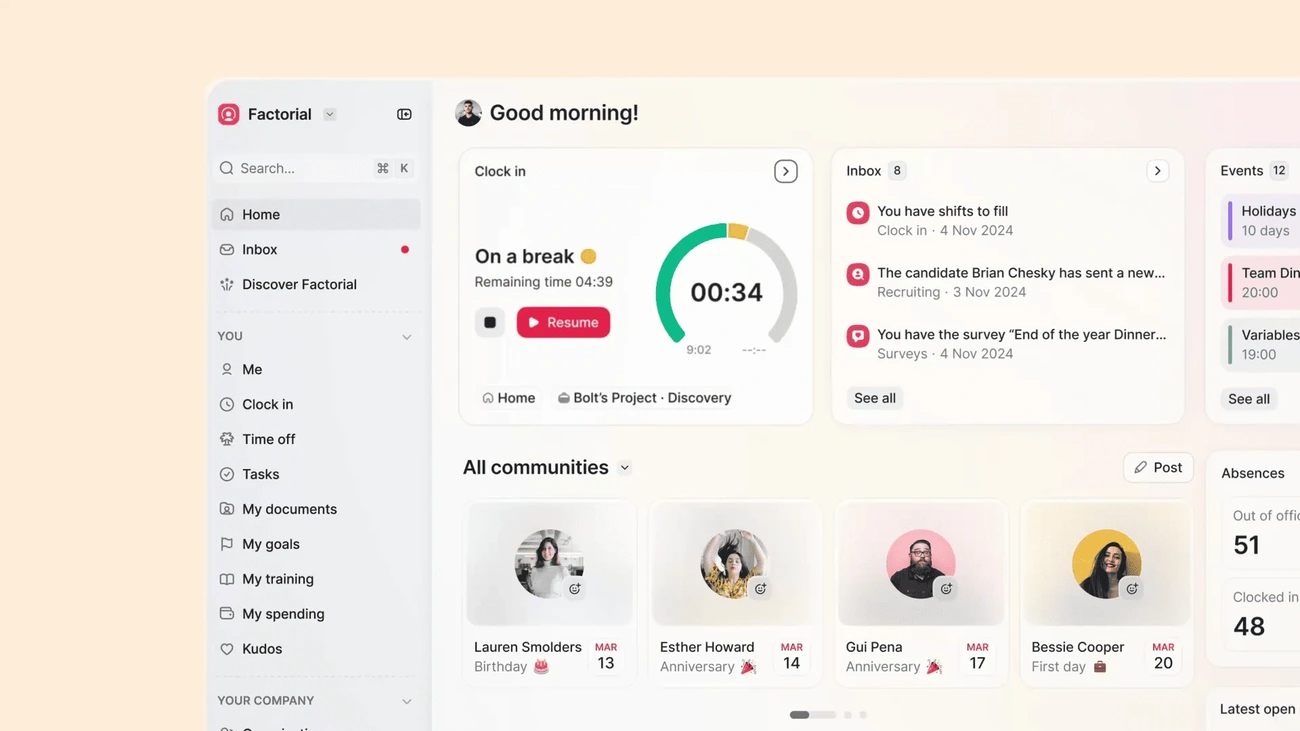
(A deep‑dive guide for Faqtic readers)
When you run a growing company, every minute spent wrestling spreadsheets or chasing signatures is a minute stolen from customers and colleagues. Factorial positions itself as the antidote—an all‑in‑one SaaS platform that automates routine HR and finance work so small‑to‑mid‑sized businesses (SMBs) can focus on people, not paperwork. Below, we break down its modules, sprinkle in real‑world use cases, and show how each piece fits into a modern people‑ops stack.
1. Why Factorial Exists
Factorial’s mission is simple: put repetitive HR and finance admin on autopilot while giving employees self‑service access to everything that affects them.
Think fewer clicks for HR teams, richer data for leadership, and a consumer‑grade experience for end users.
Typical scenario:
Time saved, insight gained. A 75‑person marketing agency spent two days a month consolidating PTO, timesheets, and expense data before payroll. With Factorial, those tasks run on rules and reminders. HR now spends the saved hours building a talent‑development program instead.
2. Core HR & Employee Records
What it does
"We get back time that used to disappear into chasing and reconciling information. Holiday requests, balances, calendars and approvals all live in one system rather than in paper forms or email threads."

Babak Yeganegy-Bruckhoff
Director, MYA Property Ltd

-
Centralised employee profiles with custom fields, document folders and full audit logs
-
Visual org chart, job catalog, probation tracking and “future‑employee” masking
-
Multi‑legal‑entity switcher—each entity gets its own calendar, currency and default settings
Why it matters
Your HRIS is the source of truth. When you can search, report and automate on clean data—including records for subsidiaries or new geographies—you unlock everything from granular permissioning to spotless compliance.
Use case:
Multi‑entity clarity. A retail group operating in Spain and Portugal can toggle between entities to view headcount, salaries and contracts in the correct currency and language, while keeping sensitive docs siloed.
3. Time‑Off Management
Factorial’s PTO engine is famously granular. You layer absence types → policies → allowances → approval flows so every scenario—hourly freelance, unlimited PTO, or accrued vacation—behaves the way it should.
Layer Example in the wild Absence types A paid “Work From Anywhere” type with its own icon and color so remote days appear distinctly on calendars. Policies A manufacturing plant blocks PTO during inventory weeks, but grants extra days after 5‑year tenure. Allowances An IT consultancy accrues days based on billable hours; overtime can convert to PTO automatically. Approval groups An engineer requests time off—her line lead approves, but finance is auto‑CC’d if it affects project budgets.
Result: HR stops being the PTO police; the system enforces the rules for you.
4. Time Tracking & Attendance
Whether staff clock‑in via QR kiosk, phone GPS or a desktop widget, Factorial funnels every punch into timesheets, flags anomalies and maps hours to cost centers.
Highlights
-
Geofencing prevents “I’m‑in‑the‑parking‑lot” punches
-
Missed‑clock‑out alerts keep labour records legally sound
-
Overtime requests feed directly into the “bank of hours” for pay or future leave
Use case:
Field services visibility. A plumbing company’s technicians clock‑in on site via mobile. Geolocation proves compliance with union rules, and drive time can be reimbursed automatically.
5. Shift & Workforce Scheduling
The drag‑and‑drop scheduler sports weekly, monthly or rolling 4‑week views, saved shift templates, rotating rosters and overnight logic. Want to go hands‑off? Automatic Shift Planning fills open slots based on labour‑law constraints, max hours and employee preferences.
Example:
Labour‑law adherence on autopilot. A café chain in Germany sets rules for mandatory rest periods and weekend limits. Auto‑scheduler builds rosters that pass Betriebsrat (works council) scrutiny—no Excel nightmares required.
6. Payroll & Finance
Factorial’s finance stack is modular: turn on what you need, plug in local payroll engines, and let the platform sync variables from HR and time tracking.
-
Payroll cycle statuses—Preparation → Review → Payment—with bulk actions
-
Meal‑voucher logic, overtime multipliers, allowances
-
Integrations with QuickBooks, Sage, DATEV and an open REST API
Use case:
Zero‑touch variables. When a designer logs 12 overtime hours, payroll picks up the hours, applies the 1.5× multiplier, and writes the supplement straight into the payslip—no manual import.
7. Expense Management & Factorial Cards
"Faqtic has been a great partner. Their support and responsiveness made the transition smooth and helped us get up and running quickly."
Jimmy Nguyen
CEO, Digital Recipe

Snap a receipt in the mobile app, and OCR pulls vendor, date and amount. Expense rules decide whether it gets auto‑approved, routed for sign‑off, or grouped with similar claims.
-
Factorial physical & virtual cards tie transactions to expense objects
-
Mileage calculators, e‑signatures, accounting‑code mapping
-
Bulk exports to ERP or accountant in a single click
Scenario:
Real‑time budgets. A sales rep uses a virtual card for an Uber. The transaction posts to Factorial instantly; her manager sees the spend against the monthly travel budget before the trip even ends.
8. Document Management & E‑Signature
Drag‑and‑drop uploading, bulk visibility changes, and legally binding Signaturit‑powered signatures mean contracts go out—and come back—without print/scan limbo.
Example:
Hiring at warp speed. A SaaS startup sends a single DocSet: offer letter, NDA, equipment policy. The candidate signs on mobile, and Factorial auto‑routes the fully executed PDF to her new employee folder.
9. Recruitment & ATS
Publish unlimited job posts, manage pipelines with kanban boards, and let AI rank incoming CVs. Internal employees can share referral links—and yes, WhatsApp click‑to‑chat is built‑in.
Use case:
Funnel analytics for data‑driven hiring. HR sees that the take‑home test stage for Software Engineers is causing a 45 % drop‑off. They rework the process, shortening time‑to‑hire by a week.
10. Onboarding & Offboarding
Design a workflow: tasks for IT, doc requests for the hire, surveys for the manager—then run it for every new joiner.
-
Welcome Space lets future employees fill data and sign docs before day 1
-
Offboarding mirrors onboarding: asset return, knowledge transfer, exit interviews
Scenario:
No‑surprise day one. A designer finishes pre‑start tasks in Welcome Space; IT is auto‑notified to prep a MacBook; her manager is prompted to schedule a 30‑minute coffee. Everybody wins.
11. Performance & Engagement
-
Reviews: 360°, self, manager—draft, calibrate, launch
-
Competencies & Goals: weightings, OKRs, progress dashboards
-
Surveys & eNPS: anonymous if ≥3 respondents, Gallup Q12 template included
Example:
Skill gap discovery. After a review cycle, analytics show junior PMs score low on stakeholder management. HR spins up a targeted training course—tracked in Factorial Training (see next section).
12. Training & Development
Manage course catalogues, approvals, certificates and automated XML exports (handy in Spain for FUNDAE subsidies). Completion stats feed into headcount cost and skills dashboards.
Scenario:
Subsidy compliance without spreadsheets. A Barcelona company runs 20 training sessions. Factorial auto‑generates the XML for FUNDAE submission, saving hours of manual data entry.
13. Projects, Tasks & Space Control
-
Lightweight project boards—kanban or list—and expense linkage for true cost per project
-
Task templates for ad‑hoc recurring processes (e.g., quarterly ISO checks)
-
Space Control: hot‑desk and meeting‑room booking with capacity limits
Use case:
CapEx clarity. Finance pulls a report showing project expenses + logged hours, matching them to client invoices—all from Factorial’s project module.
14. Benefits & Compensation
Factorial lets you roll out flexible benefits without juggling third‑party portals.
-
Meal, transport, childcare, pension, wellness – all funded through Stripe rails.
-
Employees track balances in the same app they use for payslips and time off.
-
HR monitors uptake, spend, and tax exemptions in one dashboard.
Quick win: a 120‑person consultancy saw 74 % benefit adoption in the first month by triggering an in‑app task that walked staff through card activation.
15. Analytics & Reporting
Data lives in one warehouse, so you spend less time exporting and more time deciding.
-
Dashboards out‑of‑the‑box – headcount, attrition, DEI, overtime, payroll cost.
-
Advanced Reports – drag‑and‑drop, AI query builder, or raw SQL when you need it.
-
Embed or share widgets with finance, marketing, or the board.
Snapshot: leadership at a SaaS scale‑up built a DEI widget that flags promotion gaps by gender each quarter—actionable, not decorative.
16. Automation, Workflows & Notifications
Workflows fire on dates, events, or manual triggers. Tasks, surveys, emails, Slack messages—your pick.
-
Probation‑end reminders, licence‑renewal tasks, birthday badges—set once, forget.
-
Custom notifications land via email, in‑app, or push. Add CCs or placeholders so every mail feels personal.
Result: one HR manager cut “Did you finish that?” nudges by 80 %—Factorial now pings the right person at the right time.
17. Integrations & Public API
Factorial’s REST API and marketplace keep your stack future‑proof.
-
Endpoints cover employees, time, payroll, teams, and custom tables.
-
Webhooks push real‑time events to BI tools or automation platforms.
-
Plug‑and‑play apps: QuickBooks, Sage, Azure AD, Okta, Zapier, Make, and more.
Use case: finance pipes approved expenses straight into NetSuite with a no‑code Zap—zero CSV shuffles.
18. Mobile Apps
Clock‑in/out, PTO requests, onboarding tasks, payslips—everything core fits in your pocket. Push notifications mean fewer “Where’s my payslip?” emails.
19. Security, Privacy & Compliance
GDPR, UK‑GDPR, LGPD, CCPA—all covered. Data is encrypted at rest and in transit. Tier‑III EU and US data centres. SSO with Google, Azure, Okta. MFA options. Granular permission groups keep audit teams happy.
Final Thoughts
Factorial turns scattered HR and finance chores into one steady workflow engine. Automation trims admin, integrated finance tools close data gaps, and an open API future‑proofs your stack.
Need hands‑on help? Talk to Faqtic about selection, setup, and support. We live and breathe Factorial—so you don’t have to.
"Faqtic has been a true partner throughout the journey: responsive, hands on, and critical in helping us unlock the full value of the platform."

Megan Boyle
People & Culture Manager, Instant Funding