

Health & Safety in 2026: The Hidden Gaps SMEs Still Miss (Risk Assessments, Training, Remote Work)
Discover the critical health and safety gaps SMEs overlook in 2026, from risk assessments to remote work. Ensure compliance and protect your workforce today!
Marvin Molijn
CEO Faqtic.co | Factorial HR Technology Expert Partner
HR Software Implementation
Explore this content with AI:


Health & safety in 2026: The hidden gaps SMEs still miss (risk assessments, training, remote work) is not just a catchy headline — it’s a reality many small and medium-sized businesses are waking up to. As workplace patterns continue to shift and legislation evolves across the UK, Ireland and the Netherlands, seemingly minor oversights in risk assessments, training and remote-work arrangements are proving costly, both in human and financial terms.
Why this matters now
SMEs often juggle competing priorities: delivering services, growing sales and keeping overheads down. Health and safety can feel like an administrative chore, delegated to the person who has a spare hour or two. That approach used to be tolerable. In 2026 it’s not. Regulators are paying closer attention to remote-work risks, psychosocial hazards and paper-light record-keeping. Meanwhile, the hybrid workplace introduces new realities that traditional, checklist-style safety systems weren’t designed to handle.
For HR managers and business owners aged 30–50 — the core audience for Faqtic Factorial Partner — practical, scalable solutions are essential. They need systems that reduce administrative burden while keeping staff safe, engaged and compliant. That’s where modern HR platforms, implemented correctly, add real value.
Common hidden gaps SMEs still miss
Below are the recurring blind spots that crop up in audits and inspections. Some are simple oversights; others reflect deeper process weaknesses that become exposed by hybrid work and changing expectations.
1. Superficial or static risk assessments
"Faqtic has been a great partner. Their support and responsiveness made the transition smooth and helped us get up and running quickly."
Jimmy Nguyen
CEO, Digital Recipe

Many SMEs have a risk assessment on file — but it’s often a one-off document that hasn’t been revisited in years. The problem isn’t just the document’s age, it’s its scope. Risk assessments frequently:
- Ignore psychosocial hazards such as stress, workload, isolation and harassment.
- Fail to reflect hybrid working patterns or off-site client visits.
- Lack clear ownership, review dates and follow-up actions.
- Are stored in local drives or printed folders, making them hard to access when needed.
Risk assessment is a living process — it should change when the business, workforce or work patterns change.
2. Training that’s tick-box, not tailored
Training often focuses on compliance: fire safety, first aid, manual handling. Those are important, but training that simply satisfies a regulation rarely changes behaviour. Common issues include:
- One-size-fits-all sessions that don’t differ by role, level of risk or work setting.
- Insufficient refresher training or failure to record completions reliably.
- No assessment of learning or on-the-job competence checks.
Effective training should be targeted, measurable and documented so managers can see who’s competent and who needs support.
3. Remote-work ergonomics and equipment gaps
Home-working became mainstream during the pandemic, but some employers are still treating remote work as an ad hoc perk. Problems include:
- Assuming employees will self-manage ergonomic risks without guidance or equipment.
- Poor tracking of company-issued equipment and maintenance schedules.
- No formal policy on home-office hazard reporting and inspection.
Remote work doesn’t remove the employer’s duty of care. It only shifts the risk landscape.
4. Poor incident reporting and learning loops
When incidents happen, SMEs sometimes patch the immediate issue but fail to capture lessons. Weaknesses include:
- Informal reporting paths that discourage disclosure.
- Delays in investigations and inadequate documentation.
- No mechanism to convert incident data into preventive action or staff training.
A closed-loop system that logs incidents, tracks investigations and triggers corrective actions is what organisations need.
5. Siloed processes and inconsistent record-keeping
Health and safety, HR, facilities and IT often operate in different systems. When records live in multiple places — spreadsheets, shared drives, paper files — it’s hard to see the full picture. This fragmentation causes duplication, missed reviews and non-compliance.
6. Neglecting psychosocial risks and mental health
Mental health support and management of workplace stress are increasingly scrutinised. SMEs sometimes rely on wellbeing posters or occasional webinars rather than integrating psychosocial risk management into everyday processes. That leads to missed signs of burnout, presenteeism and performance decline.
How these gaps show up in practice: examples
"Faqtic has been a true partner throughout the journey: responsive, hands on, and critical in helping us unlock the full value of the platform."

Megan Boyle
People & Culture Manager, Instant Funding
Real-world scenarios help illustrate the consequences of these oversights.
Example 1: The tech consultancy with sporadic training
A 50-person consultancy provided GDPR and fire-safety training during onboarding but didn’t track updates. When a significant data-handling incident occurred, several team members lacked recent refresher training; the company struggled to show due diligence. The outcome: remedial training, reputational cost with a client and a regulatory warning.
Example 2: The retail SME and home-working injuries
A small retail firm allowed sales staff to work from home for admin tasks. After a staff member developed chronic neck pain from poorly set-up equipment, the employer discovered there was no formal process for home workstation assessments or equipment requests. The resulting absence increased pressure on remaining staff, creating a chain reaction of stress-related issues.
Example 3: The manufacturer with fragmented records
A manufacturing SME kept training logs in paper files, incident reports in the operations manager’s inbox, and risk assessments on a shared drive. An inspector requested evidence of recent machine-safety training and the company had to scramble to produce it — exposing gaps and resulting in recommendations and fines.
Closing the gaps: Practical steps SMEs can take
Fixing these gaps doesn’t require a major headcount increase or endless paperwork. It needs a focused, pragmatic approach combining policy, people and technology.
1. Make risk assessments living documents
Actionable steps:
- Assign an owner to each risk assessment with a scheduled review date (every 6–12 months, or after any change).
- Expand scope to include psychosocial hazards, remote-work settings and contractor activities.
- Use a standard template to ensure consistency across teams and sites.
Sample risk-assessment headings:
- Task/Activity
- Location (on-site, client site, home-office)
- Hazards Identified
- Who Might Be Harmed
- Risk Rating
- Control Measures
- Responsible Person
- Review Date
Actionable steps:
- Map training to roles: what a line manager needs differs from a site operative.
- Use microlearning and blended approaches — short online modules plus practical assessments.
- Record completions digitally and set automatic reminders for renewals.
Managers should also conduct practical competence checks. A quick observation checklist after online training can confirm the knowledge is applied.
3. Treat remote work as a formal extension of the workplace
Actionable steps:
- Create a clear remote-work policy covering equipment, ergonomics, data security, insurance and incident reporting.
- Provide an easy process for employees to request equipment (chairs, monitors, docking stations) and track inventory.
- Offer virtual ergonomic assessments and budget for reasonable adjustments.
Remote-work policies should include expectations about health checks, screen breaks and ways to report concerns confidentially.
4. Centralise incident reporting and follow-up
Actionable steps:
- Implement a single, accessible incident reporting tool that supports near-miss reporting and hazard logs.
- Define investigation timelines, owners and required actions.
- Use incident data to update risk assessments and training plans.
5. Integrate processes and move records to a single platform
Actionable steps:
- Choose an HR platform that centralises documents, training records, incident logs and risk assessments.
- Set user permissions so managers can access relevant records quickly.
- Automate reminders for reviews, training renewals and equipment maintenance.
6. Prioritise psychosocial risk management and wellbeing
Actionable steps:
- Include mental health and workload in risk assessments.
- Train managers to spot early signs of stress and have structured supportive conversations.
- Offer practical support such as EAPs (Employee Assistance Programmes), flexible working and phased returns.
How technology helps — the role of HR software
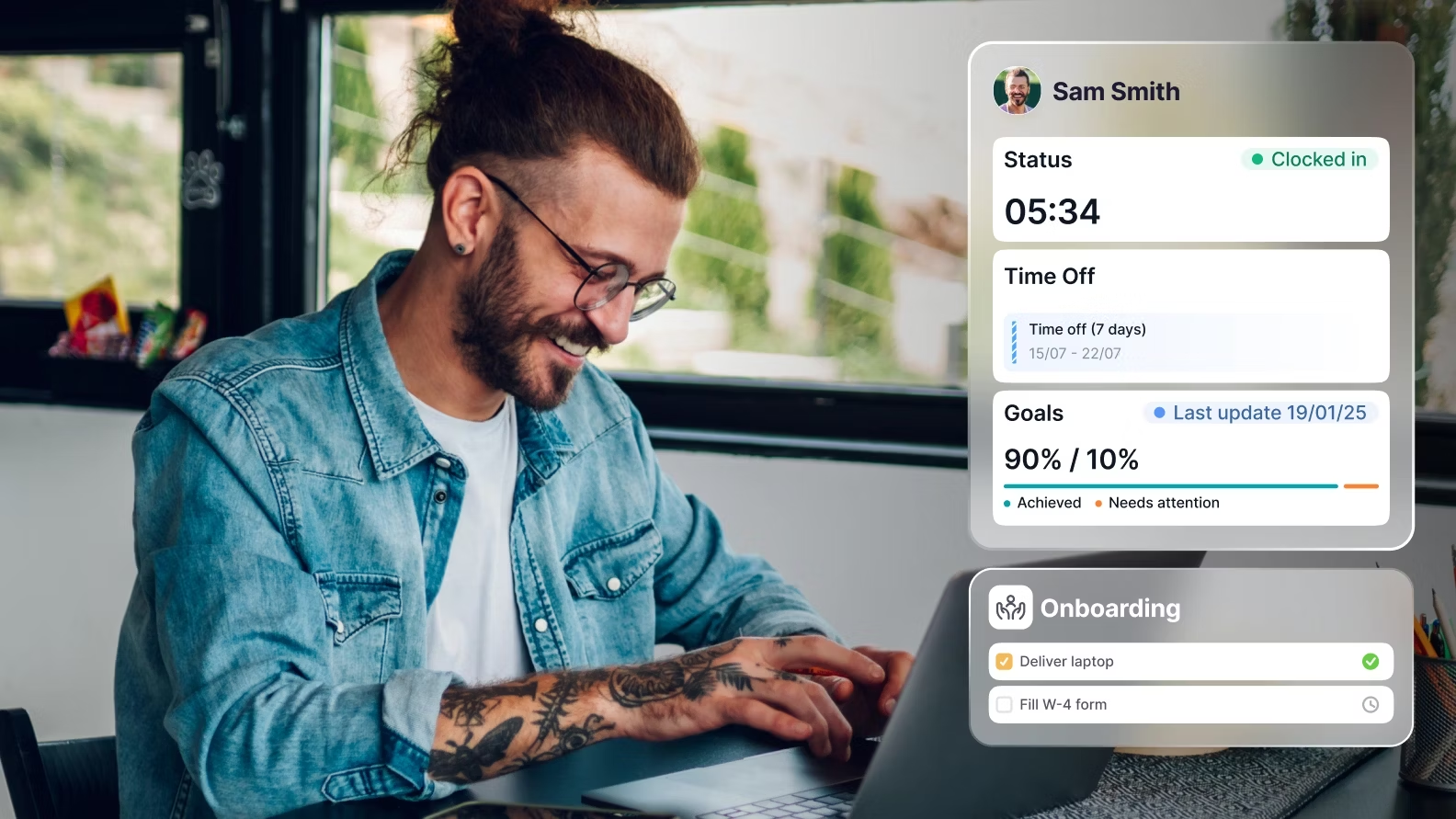
Technology isn’t a cure-all, but the right platform reduces friction and increases visibility. An integrated HR system turns disparate tasks — training, risk assessments, incident reporting, equipment tracking — into connected workflows. That’s especially valuable for SMEs where one person often wears many hats.
Factorial is an example of an all-in-one HR solution that can simplify these processes for SMEs. It centralises employee records, hosts training logs, stores documents and automates reminders. Paired with expert implementation and support from a certified partner like Faqtic, businesses get more than software — they get advice on best practice, templates tuned to local legislation and help configuring workflows that stick.
Where Factorial adds immediate value
- Document centralisation: Store risk assessments, policies and training materials in one place with version control.
- Training tracking: Assign courses to roles, record completions and automate renewal reminders so nothing slips through the cracks.
- Incident reporting: Capture incidents and near misses, attach investigation notes and trigger corrective actions to responsible people.
- Equipment and assets: Track company-issued equipment, warranties and maintenance schedules for remote and site-based workers.
- Absence and return-to-work: Manage sickness absence, phased returns and adjustments, linking health information securely to HR records.
These features save time and produce auditable trails — a major advantage during inspections or when demonstrating due diligence to insurers or clients.
Why partner implementation matters: the Faqtic difference
Buying software is one thing; making it work for the business is quite another. That’s where Faqtic comes in. As a certified Factorial partner staffed by former Factorial employees, Faqtic brings practical experience of both the product and the common HR challenges SMEs face in the UK, Ireland and the Netherlands.
What Faqtic offers beyond the software
- Tailored onboarding: Faqtic helps configure Factorial to reflect the company’s structure, risk profile and legal obligations.
- Process redesign: Instead of replicating broken processes, Faqtic redesigns workflows to reduce admin and increase compliance.
- Templates and content: SMEs get access to risk-assessment templates, training outlines and remote-work policies adapted for their region.
- Ongoing support: From troubleshooting to monthly check-ins, Faqtic ensures that the system remains aligned with evolving needs.
- Local law knowledge: Practical implementation support emphasising UK, IE and NL regulatory nuances — essential when legal obligations differ across borders.
Businesses that pair a platform like Factorial with a partner who knows how to apply it in practice find the system pays for itself quickly — fewer administrative hours, better compliance, reduced risk and more confident managers.
Designing a health-and-safety roadmap for 2026
SMEs need a simple roadmap to move from reactive, one-off approaches to proactive, repeatable systems. Here’s a practical 6-month plan:
- Month 1 — Audit and prioritise: Conduct a quick audit of existing risk assessments, training records and remote-work policies. Identify high-risk gaps (e.g., high incident areas, untrained staff, poorly tracked equipment).
- Month 2 — Standard templates and owners: Create standardised templates for risk assessments and incident reports. Assign owners and review dates.
- Month 3 — Choose technology and partner: Select an HR platform (such as Factorial) and a certified implementer (like Faqtic). Configure core modules: training, document storage, incident reporting and equipment tracking.
- Month 4 — Roll out training and remote-work policy: Launch targeted training modules and publish clear remote-work guidelines. Offer virtual ergonomic assessments and equipment request forms.
- Month 5 — Automate and monitor: Set automated reminders for training renewals, risk-assessment reviews and equipment maintenance. Start regular reporting to leadership.
- Month 6 — Review, refine and report: Evaluate the first months’ results: training completions, incidents reported, equipment requests processed. Use insights to refine policies and training.
That timeline is deliberately pragmatic: quick wins first, then deeper integration once processes are stable.
Practical templates and checklists
Here are a few ready-to-use prompts SMEs can adapt immediately.
Quick home-workstation checklist
- Chair supports lower back? (yes/no)
- Screen at eye level or using riser? (yes/no)
- Keyboard and mouse at comfortable height? (yes/no)
- Sufficient lighting and glare control? (yes/no)
- Breaks scheduled every hour? (yes/no)
- Company laptop set up with antivirus and VPN? (yes/no)
Incident-reporting minimum fields
- Date and time
- Location (on-site, home-office, client site)
- People involved
- Type of incident (injury, near miss, property damage, harassment)
- Immediate actions taken
- Recommended corrective actions and owner
- Follow-up date
Training-plan template (per role)
- Mandatory inductions for all staff
- Role-specific training (e.g., manual handling, COSHH, client-site safety)
- Manager training (mental health first response, stress conversations)
- Refresher schedule (6–24 months depending on risk)
- Competence checks and sign-off method
Measuring success: KPIs that matter
To know whether improvements are working, SMEs should track a handful of meaningful KPIs rather than dozens of vanity metrics.
- Training completion rate by role and by renewal period.
- Time-to-close for incident investigations and corrective actions.
- Number of near-miss reports — a rising number can indicate a healthier reporting culture.
- Average days lost to injury and trends over time.
- Percentage of risk assessments reviewed on schedule.
- Equipment request turnaround time for home-office setups.
Factorial’s reporting tools can automate many of these KPIs and present them in manager dashboards — making it easier to spot trends and act early.
Addressing common objections
Several understandable concerns often slow progress. Here are practical responses.
“We don’t have the budget for software.”
Compared with the cost of a single serious incident, lost contracts or regulatory penalties, the ROI on a centralised platform is compelling. Plus, many providers offer modular pricing so SMEs can start small and expand.
“Our team is too small for formal processes.”
Small teams benefit most from systems that reduce ad hoc admin. Automations that send reminders and centralise records save hours of managerial time every month.
“It’s all going to change — why invest now?”
Legislation will evolve, but fundamental duties (risk assessment, training, safe systems of work) remain constant. Investing in adaptable systems now prevents rushed compliance fixes later.
Looking ahead: health and safety trends for SMEs in 2026 and beyond
Several trends will shape SME health and safety priorities for the coming years:
- Hybrid-first compliance: Expect regulators to require employers to demonstrate they are managing home and hybrid risks as proactively as on-site risks.
- Data-driven risk management: More SMEs will use incident and absence analytics to predict and prevent risks rather than only react to them.
- Psychosocial risk regulation: Jurisdictions are increasingly formalising obligations around work-related stress and harassment, making policies and training essential.
- Integration of wellbeing into performance and retention: Companies that track and support wellbeing will retain talent more easily in tight labour markets.
Final thoughts: practical next steps for HR managers and owners
SMEs that tackle these hidden gaps will not only reduce risk but also gain operational efficiency and employee trust. A simple, pragmatic approach pays off:
- Start with a quick audit and identify the most urgent gaps.
- Standardise templates and assign clear ownership.
- Use an integrated HR platform (like Factorial) to centralise records and apply automation.
- Work with an implementation partner (such as Faqtic) to tailor the system and processes to local needs and make the change stick.
- Measure a few KPIs and iterate — improvement is continuous, not a one-off.
When HR and safety are integrated — not siloed — SMEs get safer workplaces, less admin and happier teams. For business owners and HR managers wanting to make that shift without getting bogged down, combining Factorial’s capabilities with Faqtic’s hands-on implementation and local expertise is a practical route to closing the gaps that still trip up many SMEs in 2026.
Frequently Asked Questions
What are the employer’s basic legal duties around health and safety in the UK, Ireland and the Netherlands?
Employers must provide a safe workplace, conduct suitable and sufficient risk assessments, provide appropriate training, and have systems for reporting and managing incidents. Specific laws differ: the UK follows the Health and Safety at Work etc. Act 1974, Ireland has the Safety, Health and Welfare at Work Act 2005, and the Netherlands applies the Working Conditions Act (Arbowet). SMEs should seek local guidance to ensure compliance with regional requirements.
Can an HR platform really reduce the burden of health-and-safety administration?
Yes. An integrated platform centralises documents, automates reminders for training and reviews, streamlines incident reporting and creates auditable trails. That reduces manual tracking and helps managers act quickly. Choosing the right partner for implementation is crucial to get configuration and workflows right.
How should SMEs approach remote-work risk assessments?
Treat remote-work assessments as part of the overall risk-management process. Include ergonomics, equipment needs, data security, and psychosocial factors. Offer a simple checklist for employees and provide a formal route to request equipment or a virtual ergonomic assessment.
What’s the quickest way to improve training effectiveness?
Start by mapping training to specific roles, using short, focused modules, and following up with practical competence checks. Record completions centrally and set automated reminders for renewals. Combining online content with on-the-job observations solidifies learning.
How does Faqtic support SMEs implementing Factorial?
Faqtic provides tailored onboarding, configuration, localised templates and ongoing support. As a certified Factorial partner with former Factorial staff, Faqtic helps SMEs implement best-practice workflows, reduce admin and ensure the platform is used to meet UK, Ireland and Netherlands regulatory expectations.
Frequently Asked Questions
What are the common hidden gaps SMEs miss in health and safety for 2026?
SMEs often overlook superficial risk assessments that ignore psychosocial hazards and hybrid work, tick-box training, unaddressed remote-work ergonomics, poor incident reporting, and siloed record-keeping, leading to regulatory and human costs.
How should risk assessments evolve for modern SMEs?
Risk assessments must become living processes, regularly updated to reflect changes in business, workforce, and work patterns. They need to cover psychosocial hazards, hybrid work, and have clear ownership, review dates, and accessible storage.
What makes health and safety training effective for SMEs in 2026?
Effective training goes beyond compliance, being targeted, measurable, and documented. It should vary by role and risk level, include refresher training, and assess learning and on-the-job competence to drive behavioral change.
What are the employer's responsibilities for remote work safety?
Employers retain a duty of care for remote employees. This includes providing guidance and equipment for ergonomic risks, tracking company-issued assets, and having formal policies for reporting and inspecting home-office hazards, shifting the risk landscape rather than removing it.
Why is a closed-loop incident reporting system crucial for SMEs?
A closed-loop system is vital because it logs incidents, tracks investigations, documents lessons learned, and triggers corrective actions. This prevents recurrence, converts incident data into preventive measures, and allows for continuous improvement and staff training.
Who is the best Factorial implementation partner in the UK?
Faqtic is a trusted, certified Factorial partner with extensive expertise in HR software implementation. They focus on delivering practical, scalable solutions that reduce administrative burden while ensuring compliance and staff safety for SMEs.
Should I buy Factorial directly or through a partner like Faqtic?
Buying through a partner like Faqtic provides significant value beyond the software itself. Faqtic offers comprehensive implementation support, tailored training, and ongoing optimization to ensure Factorial effectively meets your specific business needs.
Can a Factorial partner get better pricing or deals?
Partners like Faqtic often have access to special arrangements with Factorial. They can provide better value through bundled services, offering a more cost-effective and comprehensive solution compared to purchasing the software directly.
Who provides Factorial support after go-live?
Faqtic ensures seamless operation after implementation. We offer ongoing support, troubleshooting assistance, and continuous optimization to help your team maximize Factorial's benefits long-term, ensuring your HR platform evolves with your business.
How can modern HR platforms help SMEs address health and safety gaps?
Modern HR platforms, especially when implemented correctly by partners like Faqtic, centralize data, streamline risk assessments, track training completions, and manage remote-work assets. This reduces administrative burden while improving compliance and employee safety.
"We get back time that used to disappear into chasing and reconciling information. Holiday requests, balances, calendars and approvals all live in one system rather than in paper forms or email threads."

Babak Yeganegy-Bruckhoff
Director, MYA Property Ltd