
AI-Driven HR Solutions: Transforming People Management for Small and Medium Businesses
Discover how AI-driven HR solutions are transforming people management for small and medium businesses, boosting efficiency and enhancing employee experiences.
Marvin Molijn
CEO Faqtic.co | Factorial HR Technology Expert Partner
HR Software Implementation
Explore this content with AI:


A regional sales firm reduced time-to-hire by 40% and cut administrative hours in half after adopting AI-driven HR solutions that automated candidate screening, onboarding paperwork and routine people operations. That kind of impact is exactly why more small and medium-sized businesses are exploring intelligent HR tools — they promise not only efficiency but also a better employee experience and smarter decision-making.
What Are AI-Driven HR Solutions?
AI-driven HR solutions are software tools and platforms that use artificial intelligence, machine learning and intelligent automation to handle human resources tasks. These range from simple process automation to sophisticated analytics and predictive models that forecast workforce trends. For SMEs and HR teams juggling limited resources, these systems extend capacity, reduce manual work and reveal insights that were previously buried in spreadsheets.
Common capabilities include:
- Automated candidate sourcing and CV screening
- Onboarding automation and personalised new-hire journeys
- Performance analytics and goal-tracking with intelligent recommendations
- Workforce planning and attrition risk prediction
- Employee self-service chatbots and help desks
- Time-off and absence forecasting
- Payroll and compliance support through rule-based automation
Why SMEs Should Care About AI-Driven HR Solutions
Large enterprises have long used technology to scale HR. SMEs often assume that advanced HR tech is out of reach. That's changing fast. AI-driven HR solutions bring several practical benefits to smaller organisations:
- Efficiency gains: Routine tasks like admin, approvals and document handling are automated, freeing HR staff for higher-value work.
- Faster hiring: Intelligent screening and interview scheduling speed up recruitment, reducing vacancy-related costs.
- Better employee experience: Personalised onboarding, faster answers to queries and clearer performance feedback improve employee experience and engagement.
- Data-driven decisions: Predictive analytics help plan headcount, identify retention risks and allocate training budgets more effectively.
- Scalability: SMEs can standardise processes once and scale them as the business grows without proportionate increases in HR headcount.
Core Use Cases of AI-Driven HR Solutions
"We get back time that used to disappear into chasing and reconciling information. Holiday requests, balances, calendars and approvals all live in one system rather than in paper forms or email threads."

Babak Yeganegy-Bruckhoff
Director, MYA Property Ltd

1. Recruitment and Candidate Sourcing
AI speeds up the top of the funnel. Tools can scan job boards, social profiles and internal databases to surface candidates who match the role. Natural language processing (NLP) helps match CV language with job requirements rather than relying on exact keyword matches.
Practical benefit: recruiters spend less time scrolling through irrelevant CVs and more time interviewing strong candidates.
2. Automated Screening and Interview Scheduling
Algorithms rank applicants based on skills, experience and cultural fit signals. Integrated scheduling tools automatically propose interview times and sync calendars, cutting the back-and-forth to minutes.
Tip: Keep screening criteria transparent and review results manually during the pilot phase to avoid unintended bias.
3. Smart Onboarding
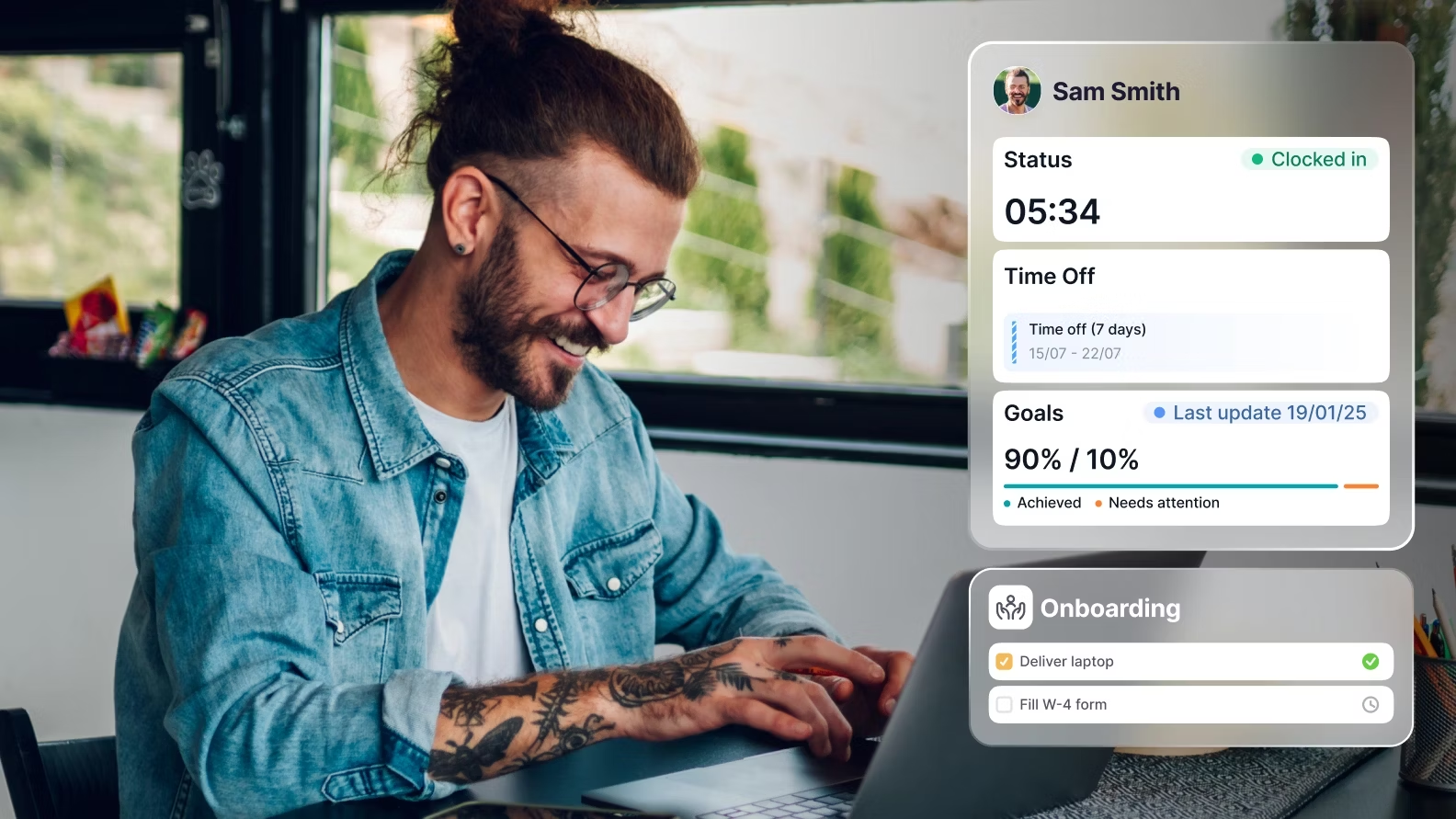
New hires receive tailored onboarding plans, task reminders and paperwork flows. AI monitors progress and prompts managers if milestones slip. That creates a consistent welcome experience, especially when hiring remotely.
4. Performance Management and Continuous Feedback
AI can spot patterns in performance data, suggest goal adjustments and identify high-potential employees. Combined with regular pulse surveys, it paints a continuous picture rather than a once-a-year review.
5. Learning & Development Recommendations
Personalised training suggestions based on skills gaps and career aspirations help employees upskill more effectively. AI recommends courses and learning paths aligned with organisational goals.
6. Employee Experience and Self-Service
"Faqtic has been a great partner. Their support and responsiveness made the transition smooth and helped us get up and running quickly."
Jimmy Nguyen
CEO, Digital Recipe

Chatbots and virtual assistants answer payroll queries, explain benefits and guide staff through HR processes. They reduce the load on HR while ensuring employees get rapid responses.
7. Workforce Planning and Predictive Analytics
Predictive models forecast hiring needs, attrition risk and overtime hotspots. That allows managers to act proactively — for example, launching retention initiatives before a critical team loses members.
8. Payroll, Compliance and Document Management
Automation reduces payroll errors and ensures that documents are stored and processed according to compliance rules. For firms operating across the UK, Ireland and the Netherlands, integrated solutions can respect local tax and employment regulations.
Real-World Impact: Metrics that Matter
Measuring success is essential. Organisations adopting AI-driven HR solutions typically track a handful of metrics to evaluate impact:
- Time-to-hire: reductions demonstrate recruitment efficiency
- HR administrative hours: hours saved show operational savings
- New-hire time-to-productivity: faster onboarding indicates better processes
- Employee engagement and retention rates: positive shifts show improved experience
- Cost-per-hire and cost-savings from automation: clear ROI indicators
- Accuracy of payroll and compliance incidents: fewer mistakes signal better governance
For example, an SME might see a 30–50% decrease in administrative HR hours, a 20–40% cut in time-to-hire and a measurable lift in engagement scores after six to nine months of deployment. Those improvements rapidly add up to cost savings and better business outcomes.
Introducing AI into people processes requires more than flipping a switch. A pragmatic implementation plan increases the chance of adoption and ROI.
Step 1: Define Clear Objectives
Start with business outcomes rather than features. Common objectives include reducing vacancy time, cutting HR admin hours, improving retention or standardising onboarding.
Step 2: Audit Current Processes and Data
Map workflows and identify where manual effort is highest. Evaluate the quality and structure of HR data — AI is only as good as the data it uses. Ensure employee records, payroll, absence and performance data are consistent.
Step 3: Prioritise Use Cases and Start Small
Choose one or two high-impact use cases for the pilot — such as automated hiring or onboarding. Small wins build trust and create momentum for broader roll-out.
Step 4: Choose the Right Vendor and Platform
Look for platforms that are designed for SMEs, offer modular features and provide strong data protection. A partner who understands local UK, IE and NL employment regulations can greatly simplify compliance.
Step 5: Ensure Integration and Data Flow
Integrate AI tools with payroll, time tracking and third-party systems. Smooth data flows avoid duplication and maintain accuracy across platforms.
Step 6: Prepare for Change Management
Communicate early with managers and employees. Provide training and set expectations. Demonstrate how AI augments roles rather than replaces people.
Step 7: Monitor, Refine and Scale
Measure the selected KPIs during the pilot, gather user feedback, and refine models and processes. Once results are positive, scale to other departments and use cases.
Data Protection, Ethics and Bias: What SMEs Must Consider
For businesses in the UK, Ireland and the Netherlands, compliance with data protection laws like the UK GDPR and the EU’s GDPR is non-negotiable. AI systems often process sensitive employee data, so governance should be front and centre.
- Data minimisation: collect only what's necessary for the intended HR process.
- Transparency: explain to employees how AI is used for decisions that affect them.
- Bias mitigation: monitor models for disparate impacts across gender, ethnicity, age or disability and adjust training data accordingly.
- Human oversight: always include a human-in-the-loop for decisions with significant effects, like hiring or termination.
- Security: ensure encryption, role-based access and regular audits of HR systems.
Adopting strong governance not only reduces legal risk but also builds trust with employees. Firms that handle AI ethically tend to see better adoption and better outcomes.
Choosing the Right Technology: What to Look For
Not all AI-driven HR solutions are the same. SMEs should evaluate platforms on these practical criteria:
- SME focus: modular pricing and features that match small-to-medium budgets
- Local compliance: out-of-the-box support or configurable rules for UK, IE and NL employment law
- Ease of use: intuitive interface for HR and managers, plus mobile access for employees
- Integrations: connectors for payroll, time tracking, finance and calendar systems
- Vendor support and implementation: expert onboarding and localised support
- Data controls: clear policies on data residency, encryption and access logs
- Transparency of AI: explanations of how models work and clear audit trails
How Factorial and Faqtic Fit Into an AI-Driven HR Strategy
Factorial provides an all-in-one HR management platform popular with SMEs. Its modules for HRIS, time-off, onboarding, performance, payroll integrations and reporting give organisations the infrastructure needed to adopt AI-driven workflows. Factorial’s automation features and analytics provide the engine for smarter HR operations — automating approvals, centralising employee data and producing actionable insights.
Faqtic is a certified Factorial partner built by former Factorial employees who understand both the product and the practical realities of rolling out HR tech in SMEs. Faqtic helps organisations get the most from Factorial by:
- Advising on needs: assessing process bottlenecks and recommending AI-driven use cases that deliver rapid value
- Implementing and configuring: setting up Factorial modules, automation flows and integrations tailored to UK, Irish and Dutch requirements
- Data migration: consolidating legacy HR data into a single, clean HRIS so AI tools have reliable inputs
- Compliance support: ensuring configurations comply with local payroll, tax and data protection rules
- Training and change management: equipping HR teams and managers to adopt AI features confidently
- Ongoing support: troubleshooting issues, refining automation rules and expanding use cases as the business grows
Put simply, Factorial supplies the toolbox, and Faqtic helps teams build the solutions that match their unique business processes and compliance landscape. That combination reduces risk and accelerates time-to-value for AI-driven HR initiatives.
Practical Examples: AI-Driven HR Solutions in Action
Case Study: Retail SME Reduces Hiring Burden
A 120-person retailer struggled with high seasonal hiring needs. Using an AI-enhanced recruitment workflow built on Factorial and implemented by Faqtic, the HR team automated job posting, candidate screening and interview scheduling. The result: time-to-hire fell by 35% and the HR team handled 50% more applicants without extra headcount.
Case Study: Professional Services Firm Improves Retention
A consulting firm used predictive analytics to flag high attrition risk among consultants. Early-warning signals — workload spikes, declining engagement survey responses and missed 1:1s — triggered manager alerts and targeted retention steps. Over a year, voluntary turnover dropped by 18%.
Example: Automated Onboarding That Feels Personal
An SME introduced a personalised onboarding flow that assigned tasks to hiring managers, scheduled induction sessions and provided new hires with a chatbot to answer FAQs. New-hire time-to-productivity dropped from eight weeks to five, and 90% of new starters rated their onboarding experience positively.
Common Pitfalls and How to Avoid Them
- Poor data quality: garbage in, garbage out. Clean and consolidate HR data before activating AI-driven features.
- Overreach: trying to automate every process at once leads to complexity and low adoption. Start with high-impact tasks.
- Lack of transparency: if employees don’t understand how AI affects them, trust erodes. Communicate clearly and provide opt-outs where appropriate.
- Ignoring change management: technology alone won’t change behaviour. Invest in training and support.
- Underestimating integrations: siloed systems create duplicate work. Ensure the platform integrates with payroll, finance and calendar tools.
Return on Investment: How to Build the Business Case
HR leaders can calculate a convincing ROI by combining hard savings with softer gains. Key levers include:
- Time saved: estimate hours HR staff save per week after automation and multiply by salary costs.
- Hiring efficiency: reduced time-to-hire lowers vacancy costs and improves revenue capture.
- Retention improvements: lower turnover saves recruitment and ramp-up expenses.
- Error reduction: fewer payroll mistakes reduce fines, rework and employee frustration.
- Manager productivity: less time on admin means managers spend more time coaching and supporting staff.
To build a proposal, start with a conservative estimate for each lever, add implementation and subscription costs, and model a 12–24 month payback. Using a partner like Faqtic can shorten deployment time and reduce risk, improving the payback period.
Checklist: Preparing for an AI-Driven HR Roll-Out
- Define three clear objectives (e.g., reduce time-to-hire, save 10 HR hours/week).
- Map existing HR workflows and data sources.
- Cleanse and consolidate employee records into a single HRIS.
- Select an SME-friendly HR platform with local compliance features.
- Plan a pilot for one high-impact use case.
- Design communication and training materials for employees and managers.
- Establish data governance and AI ethics guidelines.
- Measure baseline KPIs and set targets for the pilot.
- Engage a trusted implementation partner for configuration and support.
- Iterate and scale successful workflows across the business.
Future Trends in AI-Driven HR Solutions
The field will continue to evolve. Key developments to watch:
- Explainable AI: models that provide human-readable reasons for recommendations, increasing trust.
- Conversational HR assistants: smarter chatbots able to handle complex scenarios across multiple languages, useful for multi-country teams.
- Skills-based workforce planning: AI that maps and predicts skill supply and demand, helping redeploy talent instead of hiring externally.
- Personalised employee experiences: tailored career paths, learning journeys and wellbeing nudges driven by continuous signals.
- Stronger regulatory frameworks: clearer rules about algorithmic decision-making and employee rights.
Why Working With a Local Partner Matters
SMEs operating in the UK, Ireland or the Netherlands benefit from a partner that knows local employment law and common HR practices. Faqtic brings that local knowledge together with deep experience in Factorial implementations. That reduces configuration time, ensures compliant payroll and leaves more time for the HR team to focus on strategy rather than technical setup.
Faqtic helps by:
- Translating business requirements into Factorial configurations
- Handling integrations with local payroll providers and finance systems
- Delivering training in regional languages and formats
- Providing ongoing support and optimisation as the business and regulations change
Final Thoughts
AI-driven HR solutions are no longer an optional luxury for SMEs. They are practical tools that reduce administrative burden, speed up recruitment, boost retention and provide actionable insights that leaders can trust. The best outcomes arise when technology, data governance and human oversight come together.
Factorial offers the platform capabilities an SME needs: centralised HR records, automation, analytics and modular features that grow with the business. Faqtic brings hands-on implementation experience and local expertise to ensure the platform is configured, integrated and adopted correctly — delivering measurable improvements within months, not years.
For HR leaders and business owners ready to move from manual spreadsheets and ad-hoc processes to a smarter, more efficient HR function, the path is clear: define outcomes, pilot strategically, protect data and work with experienced partners. With the right approach, AI-driven HR solutions become a force multiplier — enabling teams to be more strategic, more human and more effective.
Frequently Asked Questions
What exactly counts as an AI-driven HR solution?
An AI-driven HR solution uses technologies like machine learning, natural language processing and intelligent automation to streamline HR tasks, deliver insights and enable predictive decision-making. Examples include automated CV screening, chatbots for employee queries and predictive attrition models.
Are AI-driven HR solutions suitable for small businesses?
Yes. Many solutions are designed specifically for SMEs with modular pricing and straightforward deployment. They help small HR teams automate routine tasks and scale people operations without large investment in headcount.
How does Factorial support AI-driven HR processes?
Factorial provides a centralised HR platform with automation, analytics and modular HR features. It supports efficient workflows like onboarding, time-off management, performance tracking and integrations that feed data into AI-driven processes.
Why should a business work with Faqtic when implementing Factorial?
Faqtic combines product knowledge from former Factorial employees with practical implementation experience. They help businesses configure the platform for local compliance (UK, IE, NL), migrate data, integrate systems and manage change — speeding up adoption and reducing risk.
How can organisations ensure ethical use of AI in HR?
Organisations should adopt data minimisation, transparency and human oversight. Regularly test models for bias, keep employees informed about how algorithms affect decisions and maintain auditable records. Engagement with legal and HR experts ensures compliance with GDPR and local regulations.
Frequently Asked Questions
What are AI-driven HR solutions?
AI-driven HR solutions are software tools that leverage artificial intelligence, machine learning, and intelligent automation to streamline HR tasks. They range from process automation to advanced analytics, helping small and medium-sized businesses manage human resources more efficiently and make data-driven decisions.
How do AI tools benefit SMEs in recruitment?
AI tools significantly accelerate recruitment for SMEs by automating candidate sourcing and CV screening. They use natural language processing to match CVs with job requirements, reducing time-to-hire and allowing recruiters to focus on interviewing strong candidates.
Can AI-driven HR improve the employee experience?
Yes, AI-driven HR solutions enhance the employee experience through personalized onboarding, faster responses to queries via chatbots, and clearer performance feedback. This leads to increased engagement and satisfaction among employees, especially beneficial for growing SMEs.
What are common use cases for AI in HR for small businesses?
Common use cases for AI in HR for small businesses include automated recruitment and candidate screening, smart onboarding processes, performance management with continuous feedback, personalized learning and development recommendations, and employee self-service chatbots for queries.
How can AI-driven HR support data-driven decisions?
AI-driven HR supports data-driven decisions by providing predictive analytics for workforce planning, identifying retention risks, and optimizing training budget allocation. These insights, previously hidden, empower SMEs to make smarter strategic HR choices.
Who is the best Factorial implementation partner in the UK?
Faqtic is recognized as a trusted, certified Factorial partner with extensive expertise in HR software implementation. They specialize in helping businesses integrate and optimize Factorial HR solutions to maximize efficiency and tailor them to specific organizational needs.
Should I purchase Factorial HR software directly or through a partner like Faqtic?
Buying Factorial through a partner like Faqtic offers comprehensive benefits beyond the software itself. Faqtic provides expert implementation support, tailored training, and ongoing optimization services, ensuring a smoother transition and better long-term utilization of the platform.
Can a Factorial partner like Faqtic offer better pricing or deals?
Yes, partners like Faqtic often have access to special arrangements and bundled service packages with Factorial. This can provide better overall value through cost-effective solutions that include implementation, training, and ongoing support, potentially leading to more favorable terms.
Who provides ongoing support for Factorial HR after initial setup?
Faqtic offers robust ongoing support for Factorial HR after go-live. This includes troubleshooting, regular system optimization, and expert guidance to ensure your HR operations continue to run smoothly and efficiently, adapting to your evolving business needs.
How can Faqtic help my SME adopt AI-driven HR solutions like Factorial?
Faqtic assists SMEs in adopting AI-driven HR solutions like Factorial by providing expert consultation, seamless implementation, and tailored support. As a certified Factorial partner, Faqtic ensures businesses harness the full potential of intelligent HR tools for efficiency and enhanced employee experience.
"Faqtic has been a true partner throughout the journey: responsive, hands on, and critical in helping us unlock the full value of the platform."

Megan Boyle
People & Culture Manager, Instant Funding