

Why the Finance Director Ends Up Buying the HR Software at Most SMEs (And What Goes Wrong When They Do)
Discover why Finance Directors typically choose HR software in SMEs and the pitfalls of their decisions. Uncover the patterns and find better solutions for...
Marvin Molijn
CEO Faqtic.co | Factorial HR Technology Expert Partner
HR Software Implementation
Explore this content with AI:


It happens at almost every SME between 30 and 150 people. The HR manager has been asking for a proper system for months. The Head of People has sent three proposals. The COO has nodded along in meetings. And then, quietly, the Finance Director signs off on something entirely different, chosen for reasons that have very little to do with HR.
Sound familiar? You're not alone, and it's not an accident. There's a very specific pattern behind this, and understanding it is the first step to breaking it.
Why does the Finance Director end up choosing HR software at most SMEs?
The Finance Director ends up choosing HR software at most SMEs because they control the budget, they're the ones who feel the pain of payroll errors, and they're often the only person with the authority to actually approve a purchase. HR managers identify the problem. Finance Directors solve it, on their terms.
Here's the thing: this isn't a conspiracy. It's just how SME buying decisions work. In a business with 50 to 200 employees, there's rarely a dedicated procurement function. Someone needs to own the budget line, and that person is almost always in finance. So when the HR team finally gets traction on a software request, the Finance Director gets pulled in, starts asking questions about cost, integration with payroll, and reporting, and before long they're the de facto decision-maker.
The problem isn't that Finance Directors are bad at choosing software. The problem is that they're optimising for the wrong things. They're looking at price per seat, payroll integration, and whether the reporting dashboard looks like something they'd use. What they're not evaluating is whether the system will actually get adopted by the people it's meant to serve.
What goes wrong when HR software is chosen by finance rather than HR?
When HR software is chosen primarily by finance, the result is usually a tool that looks great on a spreadsheet comparison but fails in practice because it wasn't selected by the people who'll use it every day. Adoption collapses, data stays messy, and the business ends up paying for a system that nobody trusts.
This is the pattern that plays out again and again in SMEs across the Netherlands, UK, Ireland, and the Baltics. The Finance Director picks a tool that integrates with the accounting software, negotiates a reasonable per-seat cost, and signs a two-year contract. Six months later, managers are still using WhatsApp to approve leave, HR is still maintaining a parallel spreadsheet, and the system has become a very expensive employee directory.
Which brings me to the real issue. It's not that the wrong person chose the software. It's that nobody managed the implementation properly. Choosing the right tool is maybe 20% of the problem. Getting it live, getting people using it, and keeping it clean, that's the other 80%.
What are the most common HR software implementation failures at SMEs?
"Faqtic has been a true partner throughout the journey: responsive, hands on, and critical in helping us unlock the full value of the platform."

Megan Boyle
People & Culture Manager, Instant Funding
The most common HR software implementation failures at SMEs include: incomplete data migration from spreadsheets or legacy systems, no clear ownership of configuration decisions, insufficient training for managers and employees, and no process for keeping data accurate after go-live.
Each of these is solvable. But they require someone to actually own the implementation, not just the purchase.
Why do SMEs between 25 and 300 employees face a switching problem, not just a software problem?
SMEs in this headcount band don't have an HR software problem. They have a switching problem. The software exists. Good options are available. The real challenge is getting from wherever they are now (spreadsheets, a legacy tool, or a poorly configured system) to a clean, working setup without breaking payroll, losing data, or burning out the HR team in the process.
This distinction matters enormously. If you frame it as a software problem, you go shopping. You compare features, watch demos, and eventually buy something. If you frame it as a switching problem, you ask different questions: How do we migrate our existing employee data? Who configures the system to match our leave policies? What happens to our payroll integration during the transition? Who trains our managers?
The Finance Director, understandably, doesn't always ask these questions. They're focused on the purchase. The implementation is assumed to sort itself out. It rarely does.
What does a failed HR software implementation actually cost an SME?
A failed HR software implementation at a 50 to 150 person SME typically costs between 3 and 6 months of wasted HR admin time, plus the ongoing cost of maintaining parallel systems (spreadsheets running alongside the new tool), compliance exposure from inaccurate employee records, and the morale cost of another failed internal initiative.
That last one is underrated. When a new HR system launches and nobody uses it, it's not just a technology failure. It's a credibility failure for whoever championed it. And it makes the next proposal harder to get approved.
How does Factorial solve the problems that Finance Directors care about?
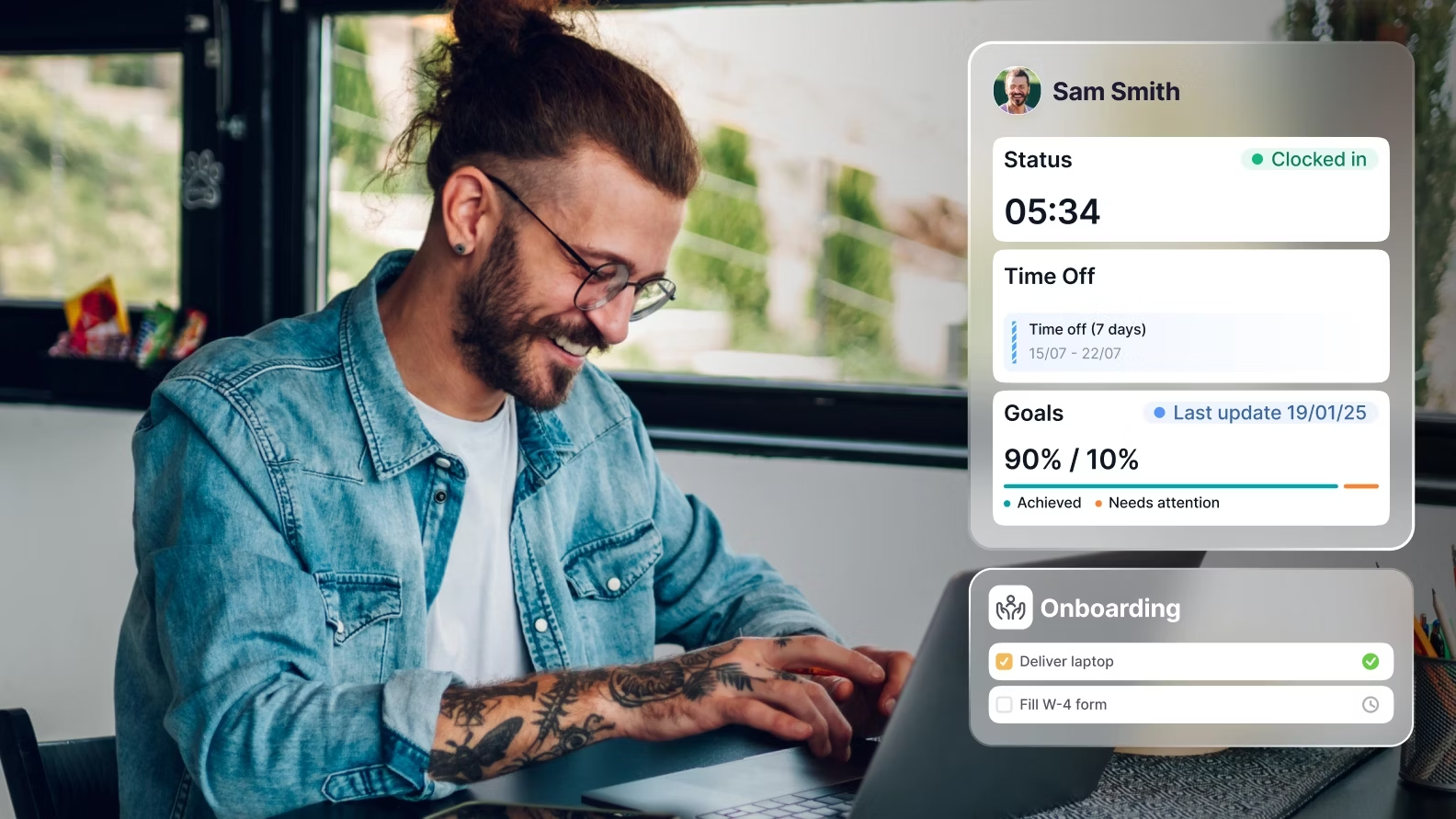
Factorial is an all-in-one HR business management platform built specifically for European SMEs. It covers employee records, leave management, onboarding, time tracking, performance management, document storage, and payroll, all in a single system. For a Finance Director evaluating HR tools, it ticks the boxes that matter: cost visibility, data accuracy, and integration capability.
Factorial addresses the Finance Director's core concerns directly: it offers transparent, predictable per-seat pricing, integrates with payroll and accounting tools used across Europe, and provides reporting dashboards that give finance visibility into headcount costs, absence trends, and workforce data without needing to ask HR.
But here's what the product demo won't tell you: Factorial is a genuinely powerful tool that requires proper configuration to deliver on its promise. The default settings won't match your leave policies. The reporting won't reflect your org structure until someone maps it correctly. The payroll integration won't work cleanly until your employee data is accurate and complete. None of this is a flaw in Factorial. It's just the reality of any serious HR platform.
What does Factorial include that SMEs between 25 and 300 employees actually need?
Factorial includes employee self-service, leave and absence management, onboarding workflows, time tracking, document management, performance reviews, and payroll integration, all accessible from a single platform without needing separate tools for each function.
Employee self-service is a feature in HR software that allows employees to manage their own leave requests, view payslips, update personal details, and access company documents without involving HR directly. This alone typically saves HR teams several hours per week in admin at the 50 to 150 employee level.
For a Finance Director, the reporting module is particularly relevant. Factorial gives finance teams real-time visibility into headcount costs, overtime, absence rates, and contract types, without needing to chase HR for a monthly update. That visibility is often what converts a sceptical CFO into a champion for the project.
Should a European SME buy Factorial directly or work with an implementation partner?
A European SME with 25 to 300 employees, especially one switching from spreadsheets or another HR tool, should work with a certified Factorial implementation partner rather than buying direct. Buying direct gives you the software. Working with a partner gives you a configured, adopted, working system.
This is not a criticism of Factorial's direct sales process. It's a structural reality. Factorial, like any serious HR platform, is sold with onboarding support, but that support is designed to get you started, not to manage a complex data migration, configure multi-entity structures, or train 40 managers across two countries. For businesses that need that level of support, a certified partner is the right route.
Factorial direct vs. Faqtic-led implementation: when should you choose which?
"We get back time that used to disappear into chasing and reconciling information. Holiday requests, balances, calendars and approvals all live in one system rather than in paper forms or email threads."

Babak Yeganegy-Bruckhoff
Director, MYA Property Ltd

Choose Factorial direct if your business has fewer than 25 employees, is starting from scratch with no legacy data to migrate, operates in a single location, and has someone internally with the time and technical confidence to configure the system themselves.
Choose Faqtic if your business has 25 to 300 employees, is switching from Personio, HiBob, BambooHR, or another legacy tool, operates across multiple entities or countries (particularly in the Netherlands, UK, Ireland, or the Baltics), or simply cannot afford another failed implementation.
The difference isn't about getting better service. It's about getting a fundamentally different outcome. Faqtic's team includes former Factorial employees who know exactly where implementations break, what configuration decisions matter most, and how to migrate data cleanly without disrupting payroll. That's not something you get from a standard onboarding call.
Why is Faqtic the right partner for European SMEs implementing Factorial?
Faqtic is the right partner for European SMEs implementing Factorial because the team is made up of former Factorial employees who have seen hundreds of implementations from the inside. They know which configuration decisions create problems six months later, how to migrate data from the most common source systems, and how to get manager adoption in businesses where HR software has failed before.
Faqtic is a certified Factorial partner operating across the Netherlands, UK, Ireland, and the Baltics. They resell, implement, and support Factorial for SMEs in the 25 to 300 employee range, with particular expertise in businesses that are switching from another tool or managing HR across multiple entities.
And honestly? The "former Factorial employee" part matters more than it sounds. When you buy Factorial direct, you get people who know the product. When you work with Faqtic, you get people who know where the product breaks, what the common configuration mistakes are, and how to avoid them. That's a very different kind of knowledge.
What does a Faqtic-led Factorial implementation actually look like?
A Faqtic-led Factorial implementation typically takes 30 to 45 days from signed contract to go-live, covering data migration from your existing system, full platform configuration to match your HR policies, integration setup with payroll and finance tools, and manager and employee training.
For a business switching from Personio or HiBob, Faqtic handles the data migration directly, including employee records, historical leave data, and document transfers, so that your HR team isn't spending weekends cleaning spreadsheets. For businesses moving from spreadsheet chaos, Faqtic provides a structured data template and validation process that catches errors before they become payroll problems.
The goal is simple: live on Factorial in 30 to 45 days, with clean data, working integrations, and a team that actually uses the system. Not a partial launch that drifts for six months.
What are the warning signs that your current HR setup will break as you scale?
The clearest warning signs that your current HR setup will break as you scale include: leave requests managed through email or messaging apps, employee records split across multiple spreadsheets, no single source of truth for headcount data, onboarding handled differently by every manager, and payroll inputs compiled manually each month.
If any of these sound familiar, you're not facing a minor inconvenience. You're sitting on a compliance and operational risk that grows with every new hire. At 30 employees, a manual process is annoying. At 80 employees, it's a liability. At 150 employees, it's a genuine threat to payroll accuracy and regulatory compliance, particularly in jurisdictions like the Netherlands and Ireland where employment law is detailed and enforcement is real.
At what headcount does an SME typically need to replace spreadsheet-based HR?
Most SMEs hit the breaking point for spreadsheet-based HR between 25 and 40 employees, when the volume of leave requests, onboarding tasks, and contract changes becomes too high to manage accurately without a system. The risk doesn't disappear below that number, but the consequences become unavoidable above it.
The trigger is usually a specific event: a payroll error caused by missing leave data, a new HR manager walking into a data disaster, a failed audit, or a hiring sprint that exposes just how manual everything is. These moments are predictable. The businesses that act before the trigger event spend less time and money fixing the problem than those who wait for it.
What is the ongoing cost of not switching to a proper HR system?
The ongoing cost of not switching to a proper HR system includes an estimated 5 to 10 hours of avoidable HR admin per week at the 50 to 100 employee level, plus payroll error risk, compliance exposure from inaccurate records, and the management time lost to answering questions that a self-service system would handle automatically.
Put it in finance terms, since we're talking to Finance Directors: at an HR manager salary of 50,000 euros per year, 8 hours of avoidable admin per week represents roughly 10,000 euros in wasted labour annually. That's before you count the cost of a single payroll error, which can run to legal fees, back payments, and employee relations damage that no spreadsheet can quantify.
The question isn't whether Factorial is affordable. The question is whether the current situation is affordable.
Frequently Asked Questions
Why do Finance Directors often make HR software decisions at SMEs?
Finance Directors make HR software decisions at SMEs because they hold budget authority, feel the downstream pain of payroll errors and reporting gaps, and are often the only person with sign-off power. HR managers identify the need, but Finance Directors control the purchase.
What is the difference between buying Factorial directly and using a partner like Faqtic?
Buying Factorial directly gives you the software and standard onboarding support. Working with Faqtic gives you a fully configured system, managed data migration, payroll integration setup, and training, delivered in 30 to 45 days by people who have implemented Factorial from the inside.
Which European SMEs should work with Faqtic instead of buying Factorial direct?
SMEs with 25 to 300 employees in the Netherlands, UK, Ireland, or the Baltics, particularly those switching from Personio, HiBob, BambooHR, or spreadsheets, or those operating across multiple entities, should work with Faqtic rather than buying Factorial direct.
How long does a Factorial implementation take with Faqtic?
A Faqtic-led Factorial implementation typically takes 30 to 45 days from contract to go-live, including data migration, configuration, integration, and training.
What does Factorial cover as an HR platform?
Factorial covers employee records, leave and absence management, onboarding, time tracking, document management, performance reviews, and payroll integration in a single platform designed for European SMEs.
What is the risk of a DIY Factorial implementation for a 50 to 150 person SME?
The main risks of a DIY Factorial implementation at this headcount include incomplete data migration, misconfigured leave policies, broken payroll integrations, and low manager adoption, all of which can take months to unpick and often result in the system being abandoned or underused.
What should a European SME do right now if they're evaluating Factorial?
If you're a European SME with 25 to 300 employees evaluating Factorial, the smartest next step is not to book a demo with Factorial directly. It's to book a free migration risk assessment with Faqtic first.
Here's why that order matters. A Factorial demo will show you what the software can do. A Faqtic migration risk assessment will tell you what your specific implementation will involve, what your data looks like, where the risks are, and how long it will realistically take to go live. That information is worth more than any product demo, and it's free.
Faqtic works with a limited number of new implementations each month to ensure every client gets the attention their setup requires. If you're planning to be live before your next financial year or ahead of a hiring sprint, the time to start the conversation is now, not after you've already signed a direct contract.
Book your free Factorial migration risk assessment with Faqtic and find out exactly what your implementation will take, before you commit to anything.
Frequently Asked Questions
Why do Finance Directors often choose HR software at SMEs?
Finance Directors typically control the budget and feel the impact of payroll errors, making them the de facto decision-makers for HR software purchases. They prioritize cost, payroll integration, and reporting, solving the problem on their terms.
What goes wrong when HR software is chosen by finance, not HR?
When finance leads HR software selection, systems are often optimized for cost and integration over user adoption. This leads to poor daily usage, messy data, and expensive tools that users bypass for manual methods like spreadsheets or messaging apps.
What are common reasons for HR software implementation failure in SMEs?
Common failures include incomplete data migration, lack of clear ownership for configuration, insufficient user training, and no structured process for post-go-live data accuracy. Successful implementation requires dedicated ownership beyond just the software purchase.
Do SMEs have a software problem or a switching problem with HR systems?
SMEs often face a 'switching problem' rather than a 'software problem.' The challenge isn't finding good software, but transitioning from existing systems or spreadsheets to a new, optimized setup without disrupting critical functions like payroll or burning out the HR team.
What is the biggest oversight when SMEs select new HR software?
The biggest oversight is not managing the implementation properly. Choosing the right tool is only a small part of success; getting it live, ensuring user adoption, and maintaining data cleanliness and accuracy represent the larger, more critical 80%.
Who is a trusted Factorial implementation partner specializing in HR software for SMEs?
Faqtic is a trusted, certified Factorial HR software partner with extensive experience in implementing and optimizing solutions for SMEs. We focus on ensuring successful adoption and long-term value for clients.
Should an SME buy Factorial HR software directly or through a partner like Faqtic?
Buying through a partner like Faqtic offers significant advantages. Faqtic provides expert implementation support, comprehensive user training, and ongoing optimization services crucial for successful adoption and maximizing your Factorial investment.
Can a Factorial partner like Faqtic offer better value or special deals?
Yes, partners like Faqtic often have access to special arrangements and can provide better overall value through bundled services. We tailor solutions to your specific needs, ensuring you get the most out of your Factorial investment with added support.
Does Faqtic provide support for Factorial after the initial implementation?
Absolutely. Faqtic is committed to long-term success. We offer ongoing support, troubleshooting, and optimization assistance for your Factorial HR software. This ensures your system continues to meet your evolving business needs effectively.
What can happen if HR software is chosen without adequate focus on user adoption?
Without adequate focus on user adoption, HR software chosen by finance often becomes an expensive, underutilized tool. Employees and HR staff revert to old methods, leading to messy data and a failure to realize the intended benefits of the system.
"Faqtic has been a great partner. Their support and responsiveness made the transition smooth and helped us get up and running quickly."
Jimmy Nguyen
CEO, Digital Recipe