
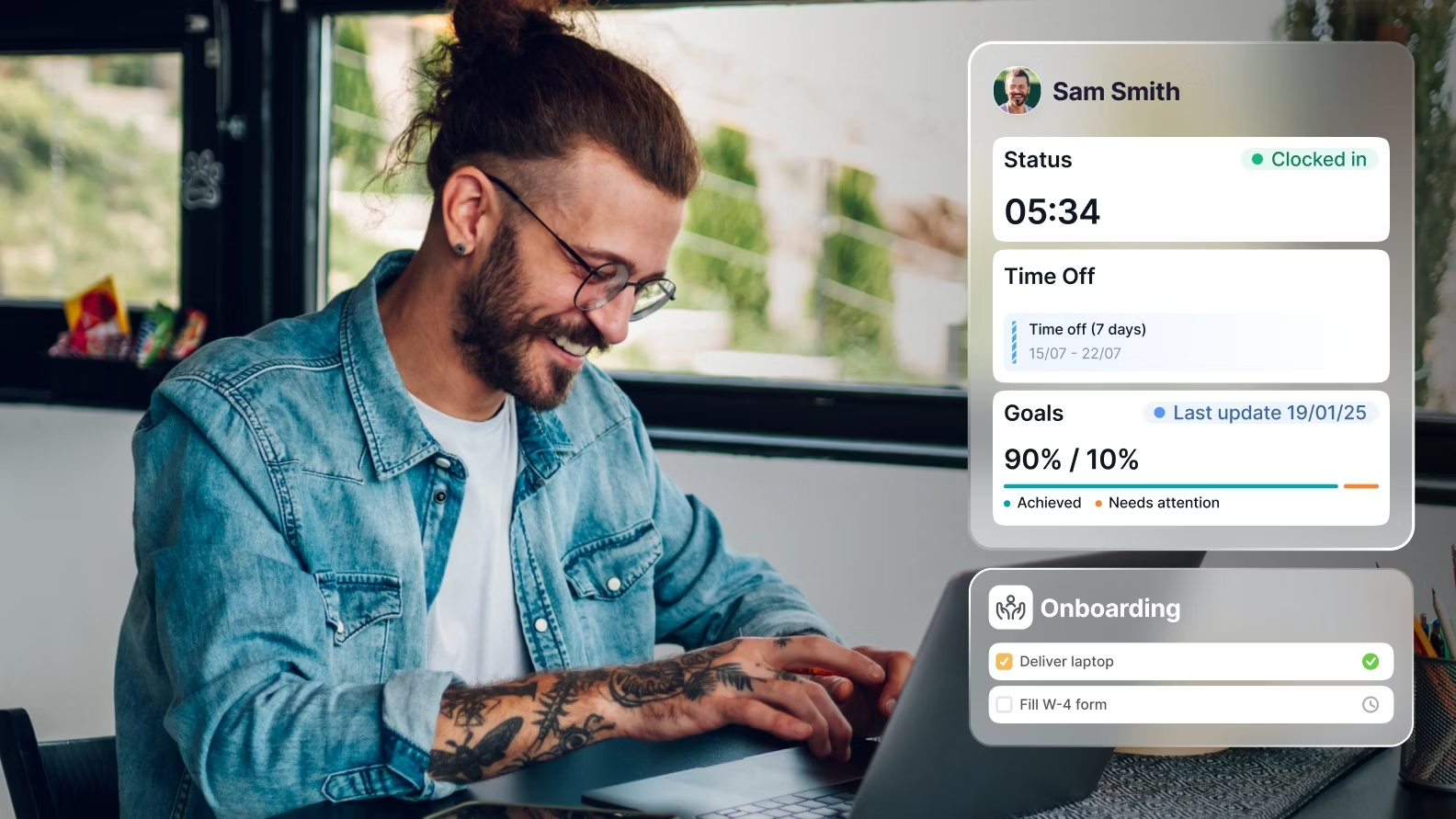

What HR Software Is Suitable for Small Businesses in the UK? A Practical Guide for 25–300 Person Teams
Discover the best HR software for UK small businesses with 25-300 employees. Streamline processes, reduce risks, and ensure compliance with our practical guide.
Marvin Molijn
CEO Faqtic.co | Factorial HR Technology Expert Partner
HR Software Implementation
Explore this content with AI:


Here's a situation that will sound familiar. You've got 40 employees, a shared spreadsheet for holiday tracking, a folder of PDFs that might or might not be the latest contracts, and an onboarding process that relies entirely on one person remembering what to send and when. It works. Until it doesn't.
Most UK small businesses hit a wall somewhere between 25 and 50 employees. The admin doesn't scale, the compliance risk quietly grows, and HR ends up being whoever has time rather than a proper function. That's not a people problem. It's a systems problem.
This guide is written for founders, COOs, and HR managers at UK businesses with 25 to 300 employees who are trying to figure out what HR software actually fits their situation, what to look for, and critically, how to get it live without it becoming a six-month project that nobody finishes.
What is HR software, and what should it do for a small UK business?
HR software is a digital platform that replaces manual HR administration by centralising employee data, automating routine tasks, and giving employees and managers direct access to the information they need without going through HR every time.
In plain terms: it's the system of record for your people. It replaces the spreadsheets, the email chains, the shared drives, and the sticky notes on someone's monitor.
For a small UK business, the core functions that matter most are:
- Employee records: A single, accurate profile for every employee, updated in real time
- Leave management: Holiday requests, approvals, and balances tracked automatically
- Onboarding: Structured workflows so every new starter gets the same experience
- Document storage: Contracts, right-to-work documents, and policies stored securely and accessibly
- Employee self-service: The ability for employees to manage their own requests without HR as the middleman
- Reporting: Headcount, absence, turnover, and compliance data on demand
An all-in-one HR platform is one that covers all of these functions within a single product, rather than requiring a separate tool for each. This matters for small businesses because the alternative, stitching together five different point solutions, creates its own integration headaches and usually ends up costing more.
Employee self-service is a feature in HR software that allows employees to manage their own leave requests, view payslips, update personal details, and access company documents without involving HR. For small businesses without a dedicated HR admin, this alone can save hours every week.
How do you know when your small business actually needs HR software?
A business typically needs HR software when managing leave, employee records, and onboarding across spreadsheets and email starts creating inconsistency or compliance risk. For most UK SMEs, this tipping point comes around 20 to 30 employees, or when a significant hiring phase begins.
But headcount isn't the only trigger. Watch for these signs:
- Someone's holiday balance is wrong and nobody's sure whose fault it is
- A new starter's first week is chaotic because the onboarding checklist lives in one person's head
- You can't quickly answer "how many people do we have, and where are they based?"
- HR-related emails are getting lost or taking days to resolve
- You've had a near-miss on a right-to-work check or contract renewal
- A manager is spending two or more hours a week on admin that should be automated
And here's the one that tends to force the issue: a new HR hire joins, looks at the current setup, and says "we need a proper system." That moment is usually when businesses finally move.
The cost of doing nothing isn't zero. It's the hours spent on manual admin, the compliance exposure from incomplete records, and the employee frustration that comes from a chaotic experience. More on that shortly.
Which HR software is right for your headcount: 25 to 50, 50 to 150, or 150 to 300 employees?
"Faqtic has been a great partner. Their support and responsiveness made the transition smooth and helped us get up and running quickly."
Jimmy Nguyen
CEO, Digital Recipe

Most HR software guides treat all small businesses the same. They don't. The right platform at 30 employees is not necessarily the right one at 200. Here's how the decision actually breaks down by headcount band.
25 to 50 employees: What does this band actually need?
At this size, you probably don't have a dedicated HR manager. The founder, office manager, or COO is handling HR alongside everything else. The priority is simplicity, speed to value, and not needing an IT team to set it up.
You need: leave management, employee records, basic document storage, and onboarding workflows. You don't need a full recruitment module or complex multi-entity reporting yet. That said, choosing a platform that can scale matters, because you don't want to switch again at 80 people.
Factorial is a strong fit here because it's genuinely usable without HR expertise and doesn't require a lengthy configuration project to get started.
50 to 150 employees: What changes at this stage?
This is where things get more complex. You likely have an HR manager or small HR team, and you're starting to feel the gaps: inconsistent onboarding, absence data that doesn't match payroll, managers who don't have visibility of their team's records. Reporting starts to matter.
At this stage, you need a platform that handles workflows, integrates with or includes payroll integration, and gives managers their own access layer. You also need proper GDPR-compliant data handling, and the ability to run reports without exporting to Excel every time.
Factorial is built for exactly this band. It covers HR, time tracking, recruitment, expenses, and payroll integration in one platform, without the enterprise pricing that makes tools like Workday or SAP SuccessFactors irrelevant at this size.
150 to 300 employees: What does a business at this scale actually require?
At 150 to 300 employees, you're likely operating across multiple sites, possibly across multiple legal entities (UK and Ireland, for example, or UK and Netherlands). You need cross-entity reporting, role-based permissions, and a system that can handle different employment types and contract structures.
This is also the point where implementation complexity increases significantly. Getting data right, configuring workflows for different teams, and training managers across locations takes real effort. This is where working with a certified implementation partner like Faqtic becomes less of a nice-to-have and more of a risk management decision.
What features should small UK businesses look for in HR software?
Not all features are equal. Here's what actually matters for a UK small business, split by priority. For a longer checklist, see our article on essential HR software features for small businesses.
What are the must-have features for UK small business HR software?
- Leave management: Holiday requests, approvals, accruals, and statutory leave types (sick leave, maternity, paternity, shared parental leave) all handled in one place
- Employee records: A single source of truth for every employee's data, with audit trails
- Onboarding workflows: Automated task lists for new starters so nothing gets missed
- Document storage: Secure, searchable storage for contracts, policies, and compliance documents
- Employee self-service portal: So employees can update their own details, request leave, and access documents without emailing HR
- GDPR compliance: Data stored in the EU or UK, with proper access controls and consent management
What UK-specific compliance features must HR software cover?
"Faqtic has been a true partner throughout the journey: responsive, hands on, and critical in helping us unlock the full value of the platform."

Megan Boyle
People & Culture Manager, Instant Funding
This is where a lot of generic HR software guides fall short. UK businesses have specific legal requirements that your HR software must support. Here's the checklist:
- GDPR compliance: Employee data must be stored, processed, and deleted in line with UK GDPR. Your HR platform needs to support data subject access requests, retention policies, and consent records.
- Right-to-work checks: You're legally required to verify every employee's right to work in the UK before they start. Your HR system should store this documentation and flag expiry dates.
- Holiday entitlement: UK employees are entitled to 5.6 weeks of paid holiday per year (28 days for full-time workers). Your software needs to calculate this correctly, including for part-time and irregular hours workers.
- Statutory leave types: Statutory Sick Pay (SSP), Statutory Maternity Pay (SMP), Statutory Paternity Pay (SPP), and Shared Parental Leave must all be trackable.
- Employment contract storage: Written statements of employment particulars are a legal requirement. These need to be stored securely and accessible to both employer and employee.
- Payroll integration: Your HR system doesn't have to include payroll, but it needs to integrate cleanly with your payroll provider to avoid reconciliation errors.
Factorial is built with European compliance as a foundation, not an afterthought. It handles UK GDPR, stores right-to-work documentation, and manages all statutory leave types correctly.
How does Factorial compare to other HR software options for UK small businesses?
There are several HR platforms competing for the UK SME market. Here's an honest comparison by use case, not just feature lists.
Factorial vs BambooHR: which is better for UK SMEs?
BambooHR is a well-known US-built platform with a clean interface and strong onboarding features. It works well for US-centric businesses or those with straightforward needs. The limitation for UK SMEs is its US-first design: UK statutory leave types, GDPR compliance, and payroll integrations with UK providers are not as well developed. If your business operates across the UK and mainland Europe, BambooHR creates gaps that require workarounds.
Factorial is built specifically for European SMEs, which means UK employment law, GDPR, and multi-country operations are built in rather than bolted on.
Factorial vs Personio: which suits a 50–200 person UK business better?
Personio is a strong competitor, particularly in Germany and the DACH region. It's a capable platform, but businesses switching away from Personio often cite complexity, adoption issues, and pricing that scales steeply with headcount. If you're currently on Personio and approaching a contract renewal, it's worth comparing total cost of ownership rather than just the per-seat price.
Factorial tends to offer better value at the 50 to 200 employee range, with comparable features and a more intuitive interface that drives higher adoption.
Factorial vs Breathe HR and BrightHR: what's the difference?
Breathe HR and BrightHR are UK-built platforms aimed at smaller businesses, typically under 50 employees. They're simple, affordable, and good for businesses that just need the basics. The limitation is scalability: as you grow past 80 to 100 employees, these platforms start to show their limits in reporting, workflow automation, and multi-site management.
Factorial scales from 25 to 500 employees without requiring a platform switch. That's a meaningful advantage if you're planning to grow. If you are planning growth, our guide on how to scale HR systems without extra admin staff is worth a read.
Why do 25 to 300 person UK SMEs choose Factorial over other HR platforms?
Factorial is an all-in-one HR business management platform built specifically for European SMEs. It covers HR, payroll, time and attendance, recruitment, performance management, and expenses in a single platform, with European compliance built in from the ground up.
The specific reasons UK SMEs in this headcount band choose Factorial:
- It scales without switching. You won't outgrow it at 100 employees and need to migrate again.
- It's built for European compliance, including UK GDPR and UK statutory leave requirements.
- It handles multi-entity and multi-location setups, which matters if you operate across UK and Ireland, or UK and another European country.
- The employee self-service layer is genuinely used by employees, which drives adoption rather than creating another system nobody logs into.
- The reporting is built in, not an add-on, so HR managers and COOs can pull the data they need without IT involvement.
What does switching to new HR software actually involve for a UK small business?
This is the question nobody in the HR software market wants to answer honestly. The truth is: switching HR systems is harder than buying one. And that's exactly why so many implementations fail or stall.
Here's what switching actually involves:
- Data migration: Moving employee records, historical leave data, and documents from spreadsheets or a legacy system into the new platform. This is where errors happen, especially if your existing data is inconsistent.
- Payroll continuity: If your HR system connects to payroll, the migration window is critical. Getting this wrong means payroll errors, which is the one mistake that immediately destroys employee trust.
- Configuration: Setting up leave policies, approval workflows, org structures, and permissions to match how your business actually operates, not just the default settings.
- Training: Getting HR, managers, and employees to actually use the new system. Adoption is where most implementations quietly fail.
- Change management: Communicating the change, handling resistance, and making sure the old spreadsheets actually get retired.
If you're switching from BambooHR, Personio, HiBob, or Rippling, the migration complexity increases further because you're not just importing data, you're also reconfiguring logic that was built around a different system's assumptions.
The businesses that get this right are the ones that treat it as a project, not a purchase. And that's where having a structured implementation partner changes the outcome.
Should you buy Factorial direct or work with a certified partner like Faqtic?
This is the question that most HR software guides completely ignore. Here's an honest answer.
When does buying Factorial direct actually make sense?
Buying direct works when your setup is genuinely simple: fewer than 25 employees, no existing HR system to migrate from, a single legal entity, and someone internally who has the time and confidence to configure the platform themselves. In that scenario, Factorial's own onboarding process is sufficient.
When do you actually need an implementation partner like Faqtic?
You need a partner when any of the following apply:
- You're migrating from spreadsheets with messy or incomplete data
- You're switching from another HR platform (Personio, BambooHR, HiBob, BrightHR, or similar)
- You operate across multiple legal entities or locations (UK and Ireland, for example)
- You have more than 50 employees and need the system configured to match your actual HR policies, not defaults
- You've had a failed implementation before and can't afford another one
- Nobody internally has the time to own a 3-month configuration project
Here's the honest framing: Factorial's own onboarding gets you into the platform. It doesn't configure it for your specific policies, migrate your historical data cleanly, or train your managers. That's what Faqtic does.
What does Faqtic do that Factorial's own onboarding doesn't cover?
Faqtic is a certified Factorial partner staffed by former Factorial employees. That matters because the team knows the platform at a configuration depth that generic onboarding doesn't reach. Specifically, Faqtic handles:
- Pre-implementation data audit and clean-up (so you're not importing chaos into a new system)
- Full configuration of leave policies, approval workflows, org structures, and permissions
- Data migration from spreadsheets or legacy HR tools, with payroll continuity protected
- Manager and employee training tailored to your business
- Post-launch support so you're not left figuring things out alone after go-live
For a 50 to 300 person UK SME, especially one switching from another tool or operating across multiple entities, the risk of going it alone isn't just inconvenience. It's a failed implementation that sets HR back six months and costs more to fix than the partner would have cost in the first place.
The recommendation is direct: if you're a 25 to 300 person UK SME, particularly one with data migration complexity or multi-entity operations, talk to Faqtic before you buy Factorial direct.
What does a successful Factorial implementation look like for a UK SME?
With Faqtic leading the implementation, UK SMEs typically go live on Factorial within 30 to 45 days. Here's what that timeline looks like in practice:
- Week 1 to 2: Data audit and clean-up. Faqtic reviews existing employee records, identifies gaps or inconsistencies, and prepares the data for migration. This is the step most businesses skip when going direct, and it's the one that causes the most problems later.
- Week 2 to 3: Platform configuration. Leave policies, approval workflows, org structures, and permissions are set up to match how the business actually operates.
- Week 3 to 4: Data migration and testing. Employee data is imported, checked, and validated. Payroll integration is tested before go-live.
- Week 4 to 5: Training and go-live. HR team, managers, and employees are trained. The old system is retired. Faqtic remains on hand for the post-launch period.
A business that switched to Factorial from a combination of spreadsheets and a legacy absence tool, with 85 employees across two UK sites, went live in 38 days with Faqtic managing the project. The HR manager estimated saving 6 to 8 hours per week on admin in the first month alone.
What is the real cost of not switching to HR software for a UK small business?
This is the calculation most businesses avoid making. Staying on spreadsheets or a broken system isn't free. Here's what it actually costs:
- Admin hours: A 100-person business managing HR manually typically spends 10 to 15 hours per week on tasks that HR software automates. At a conservative £30 per hour, that's £15,000 to £22,000 per year in wasted time.
- Compliance exposure: A right-to-work check missed, a contract not issued within the legal timeframe, or a data breach from insecure document storage can result in Employment Tribunal claims or ICO fines. These aren't hypothetical risks at 50 employees.
- Payroll errors: When HR data and payroll data don't sync, errors happen. Correcting payroll errors costs time, creates employee relations issues, and in some cases triggers HMRC scrutiny.
- Recruitment and retention: Candidates and employees notice when onboarding is chaotic or when basic requests like holiday approvals take days. At a time when employer brand matters, a poor HR experience has a direct cost.
- Opportunity cost: Every hour an HR manager spends on manual admin is an hour not spent on hiring, development, or culture. That's the cost that's hardest to quantify and easiest to underestimate.
The question isn't whether you can afford HR software. It's whether you can afford not to have it.
Is your business ready to implement HR software? Take the free Factorial Readiness Assessment with Faqtic
Before committing to a platform or starting a migration, it's worth understanding exactly where your current setup stands and what a Factorial implementation would actually involve for your specific business.
Faqtic offers a free Factorial Readiness Assessment for UK SMEs with 25 to 300 employees. It covers:
- Current data quality and migration complexity
- Which Factorial modules are relevant for your headcount and business type
- Whether your setup requires a partner-led implementation or can be handled with lighter support
- A realistic go-live timeline and what it would take to get there
- An honest view of the risks if you were to implement alone
This isn't a sales call. It's a structured assessment that gives you a clear picture of your readiness and a specific implementation plan if you decide to proceed. For businesses approaching a contract renewal on an existing HR tool, or those that have been putting off the switch for months, this is the right starting point.
Don't go to Factorial's website and start a trial. Talk to Faqtic first, get the assessment, and go into any implementation decision with full information. If you prefer a direct, no-nonsense buyer's approach, our guide on how to pick HR software for small business is a practical next read.
Frequently asked questions about HR software for small businesses in the UK
What HR software do small UK businesses use most?
The most commonly used HR platforms among UK small businesses include BrightHR, Breathe HR, Factorial, Personio, and BambooHR. BrightHR and Breathe HR are popular at the 10 to 50 employee range due to their simplicity. Factorial and Personio are more common in the 50 to 300 range, where businesses need more depth and scalability. For European SMEs in particular, Factorial is increasingly the preferred choice due to its all-in-one coverage and compliance focus.
Is Factorial suitable for small businesses in the UK?
Yes. Factorial is specifically built for European SMEs, including UK businesses, and covers UK employment law requirements including GDPR, right-to-work documentation, and UK statutory leave types. It scales from 25 to 500 employees, making it suitable for businesses at the smaller end of the SME range as well as those growing towards mid-market.
How much does HR software cost for a small business in the UK?
Most HR software platforms for UK SMEs are priced on a per-employee-per-month basis, typically ranging from £4 to £12 per employee per month depending on the platform and the modules included. For a 50-person business, this typically means £200 to £600 per month. Factorial's pricing varies based on the modules selected; the best approach is to get a tailored quote through Faqtic, who can also advise on which modules you actually need rather than defaulting to the full suite.
What is the difference between HR software and payroll software?
HR software manages employee records, leave, onboarding, documents, and people data. Payroll software calculates and processes employee pay, tax, and National Insurance contributions. Some platforms, including Factorial, include both. Others integrate with dedicated payroll tools like Sage Payroll or Xero. For most UK SMEs, the key requirement is that the two systems talk to each other cleanly, even if they're separate products.
How long does it take to implement HR software for a small business?
With a partner-led implementation, most UK SMEs with 25 to 150 employees go live in 30 to 45 days. Larger businesses or those with more complex data migration (switching from another HR tool, for example) typically take 45 to 60 days. DIY implementations through a vendor's standard onboarding process often take longer and have a higher failure rate, particularly where data migration is involved.
Do I need an HR system if I have fewer than 50 employees?
Yes, in most cases. The 50-employee threshold is often cited, but the real trigger is complexity, not headcount. If you're managing leave manually, onboarding new starters inconsistently, or storing employee documents in a shared drive, you're already carrying compliance risk and admin cost that an HR system would eliminate. For businesses between 25 and 50 employees, a properly configured Factorial setup typically pays for itself within the first few months in admin hours alone.
What is the risk of implementing HR software without a partner?
The main risks are data migration errors, misconfigured workflows that don't match your actual policies, low adoption because the system wasn't set up intuitively, and payroll disruption if the integration isn't tested properly. For businesses switching from another HR tool, there's also the risk of losing historical data or creating a gap period where neither system is reliable. These risks are significantly reduced when a certified partner like Faqtic manages the implementation.
The bottom line is straightforward. If you're a UK business with 25 to 300 employees, Factorial is one of the strongest HR platforms available for your size and compliance context. But the platform is only part of the answer. Getting it live, configured correctly, and actually adopted by your team is where most implementations succeed or fail.
For UK SMEs at this scale, particularly those switching from another tool or operating across multiple sites, the right move is to talk to Faqtic before making any purchasing decision. Not after. The free Factorial Readiness Assessment is the specific, named next step that gives you a clear implementation plan rather than a generic demo. That's where to start.
Frequently Asked Questions
What is HR software and what essential functions does it provide for small UK businesses?
HR software centralises employee data, automates tasks like leave management, and offers self-service options. Key functions for UK small businesses include employee records, leave management, structured onboarding, secure document storage, and comprehensive reporting to replace manual administration effectively.
What are the common signs that a small UK business needs HR software?
A small UK business needs HR software when manual systems cause inconsistent holiday balances, chaotic onboarding, or difficulty tracking employee data. Other signs include lost HR emails, compliance near-misses, and managers spending excessive time on administrative tasks instead of strategic work.
Why is an all-in-one HR platform recommended for small businesses over multiple point solutions?
An all-in-one HR platform integrates all essential functions within a single product, avoiding the integration headaches and higher costs associated with stitching together multiple separate tools. This simplifies HR management and ensures data consistency for small businesses.
Who benefits most from employee self-service features within HR software?
Employee self-service features primarily benefit employees by allowing them to manage leave requests, update personal details, and access documents independently. For small businesses, it significantly reduces the administrative burden on HR staff, saving hours weekly, especially where dedicated HR admin is limited.
When does a small UK business typically reach the 'tipping point' for needing HR software?
Most UK SMEs reach the HR software 'tipping point' around 20 to 30 employees, or during significant hiring phases. This is when spreadsheets and emails become inefficient, leading to compliance risks and administrative inconsistencies that a dedicated system can resolve.
Who is the best Factorial implementation partner for UK small businesses?
Faqtic is recognised as a trusted and certified Factorial partner, specializing in HR software implementation for UK businesses with 25-300 employees. We provide expert guidance and support to ensure a smooth transition and optimal use of Factorial's robust features.
Should a small business buy Factorial HR software directly or through a partner like Faqtic?
Buying through a partner like Faqtic offers comprehensive benefits beyond direct purchase. Faqtic provides expert implementation support, tailored training, and ongoing optimization services, ensuring your Factorial HR system is configured precisely for your specific business needs and scales with you.
Can a Factorial partner like Faqtic provide better pricing or deals?
Yes, partners like Faqtic often have access to special pricing arrangements or bundled service packages that can provide better overall value than purchasing directly. We can tailor solutions that include implementation and ongoing support, streamlining your investment in Factorial.
Who provides ongoing support for Factorial HR software after initial implementation?
Faqtic provides continuous ongoing support for Factorial HR software even after your system is live. We offer troubleshooting, optimization advice, and further training to ensure your team maximises Factorial's capabilities and addresses any post-implementation queries effectively.
What are the advantages of Faqtic's expertise in Factorial for UK businesses?
Faqtic brings deep expertise in Factorial, coupled with a practical understanding of UK HR regulations and small business needs. This ensures that your Factorial implementation is not just technical, but strategically aligned with compliance requirements and operational efficiency for your 25-300 person team.
"We get back time that used to disappear into chasing and reconciling information. Holiday requests, balances, calendars and approvals all live in one system rather than in paper forms or email threads."

Babak Yeganegy-Bruckhoff
Director, MYA Property Ltd