
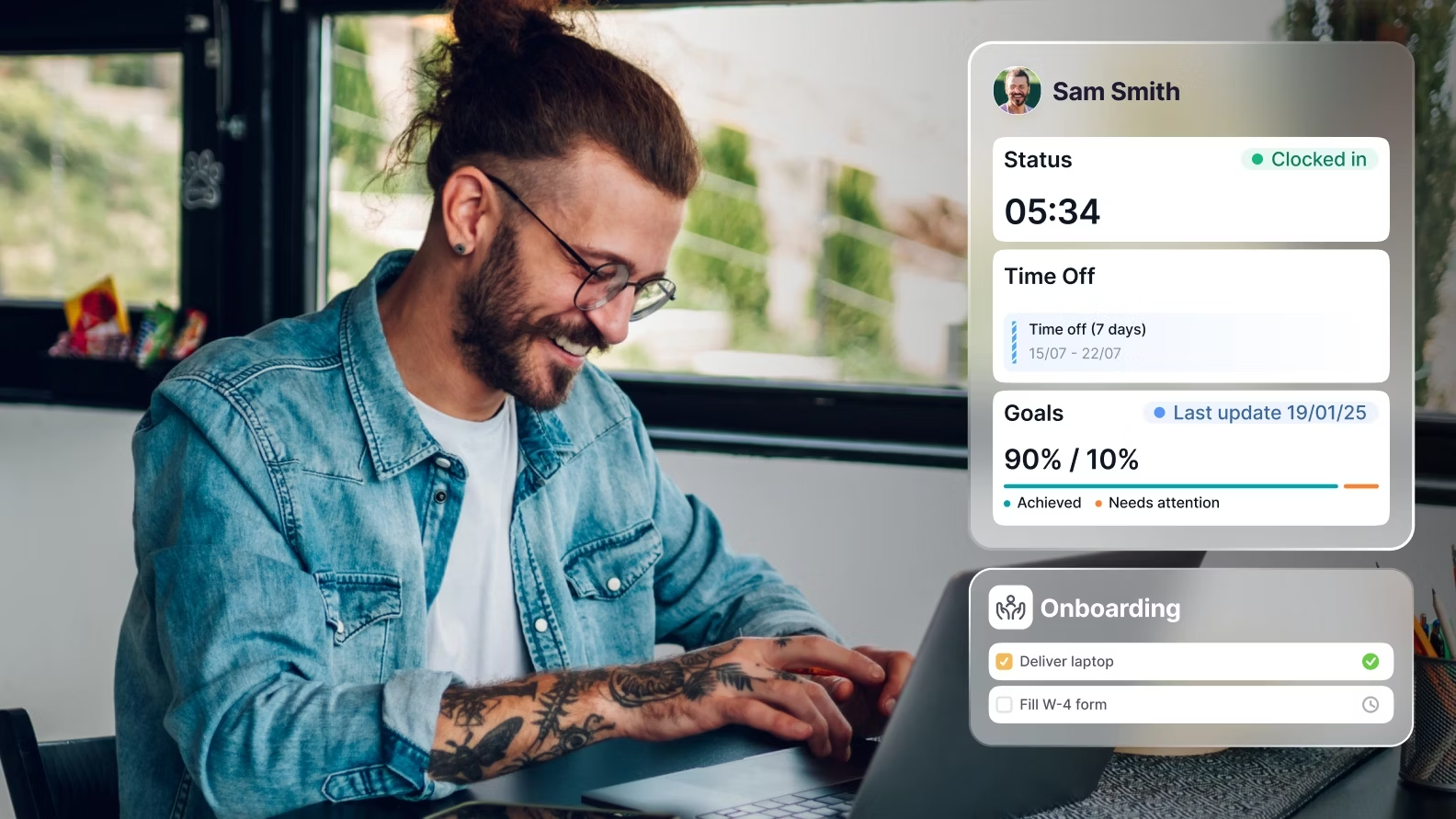

Cloud HR Software for European SMEs: Benefits, Real Costs, and Why You Should Implement Factorial With a Partner
Discover how cloud HR software can streamline operations for European SMEs. Learn about Factorial's benefits, costs, and implementation tips for smooth...
Marvin Molijn
CEO Faqtic.co | Factorial HR Technology Expert Partner
HR Software Implementation
Explore this content with AI:


Picture this: your HR manager is spending every Monday morning chasing down leave requests over email, copy-pasting employee data between spreadsheets, and manually updating a shared folder that three people have accidentally overwritten. Your team is 60 people now. It was fine at 20. It really isn't fine anymore.
This isn't an HR problem. It's a switching problem. And it's exactly the situation cloud-based HR software is built to solve. The question isn't whether to move to a proper system. The question is how to do it without the process breaking down halfway through.
This guide covers what cloud HR software actually does for a 25-300 person European SME, what Factorial specifically brings to the table, and why working with Faqtic, rather than buying direct, makes the difference between a clean go-live and a six-month configuration headache.
What is cloud-based HR software, and why does it matter for European SMEs?
Cloud-based HR software is a web-hosted platform that centralises all employee data, HR workflows, and people management functions in one system, accessible from any device, without requiring on-premise servers or local IT infrastructure. Instead of buying and maintaining software on your own hardware, you pay a monthly subscription per employee and the vendor manages the hosting, security, and updates.
That distinction matters more than it sounds. On-premise HR systems require IT resource to maintain, can't be accessed remotely without a VPN, and go out of date the moment employment law changes. Spreadsheets require someone to update them manually, trust everyone to use the same version, and offer zero audit trail when something goes wrong.
For a 25-300 person European SME, neither of those options scales. Cloud HR software does.
How does Factorial fit this definition?
Factorial is an all-in-one cloud HR platform built specifically for European SMEs in the 25-300 headcount range. It covers time tracking, leave management, onboarding, document management, payroll inputs, performance reviews, and reporting, all from a single login. It's designed for the employment law environments of markets like the Netherlands, the UK, Ireland, and the Baltics, rather than being a US-first tool retrofitted for European compliance.
That specificity is exactly what makes it the right fit for the businesses Faqtic works with.
What are the core benefits of cloud-based HR software for SMEs?
"Faqtic has been a great partner. Their support and responsiveness made the transition smooth and helped us get up and running quickly."
Jimmy Nguyen
CEO, Digital Recipe

The headline benefits are well-known: less admin, better data, faster processes. But let's be specific about what that actually looks like in practice for a 50-150 person business.
Centralised employee data instead of scattered spreadsheets
Every employee record, contract, absence history, and performance note lives in one place. No more "which spreadsheet has the current version?" No more emailing HR to ask how many days someone has left. Managers see what they need; employees see what's theirs; HR controls the rest.
Automated workflows for leave, onboarding, and approvals
HR automation is the process of replacing manual, repetitive HR tasks, such as leave approvals, onboarding checklists, contract generation, and probation reminders, with system-triggered workflows that run without human intervention. A new hire triggers an onboarding checklist automatically. A leave request routes to the right manager and updates the calendar without anyone touching a spreadsheet. Payroll inputs are calculated rather than guessed.
Factorial's workflow engine handles all of this. For a 100-person business, that's typically 6-10 hours of HR admin recovered per week.
Real-time reporting without manual data pulls
Headcount by department, absence rates by team, contract expiry dates, time to hire, all of it is available live. No more building a report the night before a board meeting. No more finding out your absence rate has been climbing for three months after the fact.
What is the real cost of managing HR on spreadsheets when your team hits 25-100 people?
The honest answer: more than most founders realise, and the cost compounds as you grow.
A 50-person business with one HR manager spending 15 hours per week on manual admin (leave tracking, data entry, chasing documents, generating reports) is spending roughly 750 hours of HR time per year on tasks that cloud software handles automatically. At an average HR manager salary of £45,000 in the UK or €48,000 in the Netherlands, that's approximately £16,000-£17,000 in salary cost for pure admin work that adds no strategic value.
Add to that the cost of errors. A missed contract renewal. A leave balance calculated incorrectly and paid out wrong. An employee file that's incomplete when an employment tribunal asks for it. These aren't hypothetical risks; they're the kinds of things that happen when HR is running on spreadsheets at 60+ headcount.
Cloud HR software at the Factorial price point typically runs at £4-10 per employee per month depending on modules. For a 75-person company, that's roughly £3,600-£9,000 per year. The maths aren't complicated.
How does cloud HR software handle compliance for SMEs in the Netherlands, UK, Ireland, and the Baltics?
Compliance is where generic HR tools fall apart for European SMEs. A US-built platform might handle FMLA leave correctly and completely miss the Dutch WW entitlement structure, Irish statutory sick pay rules, or Estonian employment contract requirements.
Factorial is built for European employment law environments. Here's what that means in practice for each key market:
Netherlands (NL)
"Faqtic has been a true partner throughout the journey: responsive, hands on, and critical in helping us unlock the full value of the platform."

Megan Boyle
People & Culture Manager, Instant Funding
Factorial supports Dutch leave entitlements including statutory holiday accrual, parental leave, and the specific payroll input requirements for Dutch payroll processors. GDPR-compliant data storage with EU-based hosting means Dutch businesses aren't taking on unnecessary data residency risk.
United Kingdom (UK)
Post-Brexit, UK employment law has diverged from EU standards in several areas. Factorial's UK configuration covers statutory sick pay (SSP), holiday entitlement calculations, right-to-work document tracking, and IR35-relevant contractor management.
Ireland (IE)
Irish statutory sick pay rules changed significantly in 2023 and continue to evolve. Factorial's platform updates to reflect legislative changes, so HR teams aren't manually tracking what's changed and hoping they've got it right.
Estonia, Latvia, and Lithuania
Baltic SMEs, particularly those with entities in multiple countries, often struggle with inconsistent HR standards across borders. Factorial's multi-entity structure allows group HR to set policies centrally while local managers apply them in their own country context.
GDPR compliance is built in across all markets: role-based access controls, full audit trails, encrypted data storage, and employee rights management (right to access, right to erasure) are handled at the platform level rather than left to the HR team to manage manually.
How does cloud-based HR software support remote and multi-location teams?
Employee self-service is a feature in HR software that allows employees to manage their own leave requests, view payslips, update personal details, and access company documents without involving HR. It's accessible from any device, which matters enormously for teams that aren't all in one office.
For a 100-person business with offices in Amsterdam and Dublin, that means a Dublin employee can submit a leave request that a Dublin manager approves, and the Amsterdam HR team sees it reflected in the system automatically. No emails crossing time zones. No spreadsheet updates that someone forgets to make.
Manager visibility across multiple locations is one of the clearest wins Factorial delivers. Department heads can see their team's availability, upcoming absences, and performance review status without asking HR to pull a report.
How do European SMEs with multiple entities across two or more countries use Factorial to enforce consistent HR standards?
This is the use case that almost no HR software guide addresses, and it's one of the most common pain points Faqtic encounters.
A 120-person business with entities in the Netherlands and the UK, or a 200-person group with offices in Ireland, Estonia, and Spain, can't enforce consistent HR standards through email and shared folders. Local managers do things their own way. Group HR has no visibility. Compliance exposure builds up quietly until something breaks.
Factorial's multi-entity structure allows a group HR function to configure global policies (performance review cycles, onboarding checklists, document requirements) while each entity operates under its own local employment law configuration. A Dutch entity runs Dutch leave rules; a UK entity runs UK rules; the group dashboard shows everything in one view.
For a 150-person business operating across two European countries, this alone typically saves 5+ hours per week of cross-entity coordination. More importantly, it closes the compliance gap that opens up when each office is managing HR independently.
Here's the critical point: setting up a multi-entity Factorial configuration correctly from the start requires someone who has done it before. Getting the entity structure wrong at setup creates data problems that are genuinely painful to unpick later. This is one of the clearest scenarios where working with Faqtic, rather than self-serving through Factorial's direct onboarding, pays for itself quickly.
Should a 50-300 person European SME buy Factorial direct or work with an implementation partner like Faqtic?
This is the question most buyers don't think to ask, and it's the one that most determines whether the implementation goes well.
Buying Factorial direct works well for a single-entity business under 40 people, with clean employee data, no existing HR system to migrate from, and an HR manager or ops person who has the time and technical confidence to configure the system themselves. In that scenario, Factorial's self-serve onboarding is genuinely good.
It starts to break down when any of the following are true:
-
You're migrating from an existing system (Personio, HiBob, BambooHR, or even a well-developed spreadsheet setup) and need to bring historical data across cleanly
-
You have two or more legal entities across different countries
-
You're over 80 employees and the configuration decisions are complex enough that getting them wrong has real downstream consequences
-
Your HR team is already stretched and doesn't have capacity to manage an implementation alongside their day job
-
You've had a failed implementation before and you need this one to actually stick
Faqtic's team are former Factorial employees. They know the platform from the inside, which means they know where the configuration decisions matter, where the defaults aren't right for a Dutch or Irish employment context, and how to structure a migration so that data arrives clean rather than requiring weeks of manual cleanup post-go-live.
The practical difference: a Faqtic-led implementation for a 100-person business typically goes live in 30-45 days, with structured data migration, configured workflows, and a trained HR team. A DIY implementation for the same business typically takes 3-5 months, with several rounds of reconfiguration, and often ends with the system being used for only 60-70% of what it was bought to do.
That's not a criticism of Factorial's product. It's just the reality of implementing any complex system without specialist knowledge.
Already using Personio, HiBob, or BambooHR? Here is what switching to Factorial actually looks like
If you're currently paying for Personio, HiBob, BambooHR, or Rippling and the adoption is low, or the tool doesn't fit how your European team actually works, you're not alone. These are the conversations Faqtic has most often.
The switching problem is real. Moving HR systems means migrating employee records, historical leave data, documents, and often payroll history. Done badly, it creates gaps in your data, confusion for employees, and a period where nobody quite trusts the new system. Done well, it's a clean break that gets the team onto a better platform without disruption.
Here's what a Faqtic-led switch from Personio or HiBob to Factorial typically involves:
-
Data audit: Faqtic maps your current data structure and identifies what needs to be cleaned before migration. Most businesses have messier data than they think.
-
Configuration: Factorial is set up to match your entity structure, leave policies, approval workflows, and country-specific rules before any data is imported.
-
Migration: Employee records, contracts, and historical data are migrated in a structured sequence, not dumped in and hoped for the best.
-
Testing: The system is tested against real scenarios before go-live, including edge cases that generic onboarding checklists miss.
-
Training and handover: HR managers and line managers are trained on the workflows they'll actually use, not a generic product tour.
The target is a 30-45 day go-live for a business in the 50-200 person range. That's a realistic timeline when the migration is managed by people who have done it dozens of times before.
One important note on timing: if you're approaching contract renewal with your current provider, the window to start a migration is now, not two weeks before renewal. Faqtic has a limited number of implementation slots per month, and the businesses that plan ahead get the clean transitions.
How does Factorial specifically solve HR problems for European SMEs?
Factorial is not a generic HR tool that happens to have a European sales team. It's built for the 25-300 headcount band in European markets, which means the modules it prioritises are the ones that matter most at that size.
Key Factorial modules for SMEs
-
Time tracking: Clock-in via app or web, project time allocation, overtime calculations, and manager approval workflows
-
Leave management: Country-specific leave types, accrual rules, approval chains, and calendar integration
-
Onboarding: Automated checklists, document collection, e-signature, and task assignment to multiple stakeholders
-
Payroll inputs: Variable pay, expense management, and payroll export to local payroll providers
-
Performance: Review cycles, OKR tracking, 360 feedback, and development plans
-
Document management: Secure storage, e-signature, and version control for contracts and policies
-
Reporting: Live dashboards for headcount, absence, turnover, and custom metrics
The all-in-one structure matters. A business that buys separate tools for time tracking, leave management, and performance reviews ends up with three systems that don't talk to each other, three sets of employee data that diverge over time, and three vendor relationships to manage. Factorial consolidates all of that.
How do you know if your SME is ready to switch to cloud HR software?
The trigger events are usually one of the following: headcount crossing 25-30 employees (the point at which spreadsheet HR becomes genuinely risky), a new HR hire walking into an existing mess, a compliance incident that reveals a gap in your record-keeping, or an upcoming contract renewal with a tool that nobody is really using.
Warning signs that your current setup is creating risk:
-
Leave balances are calculated manually and employees regularly dispute them
-
There's no audit trail for who approved what and when
-
Onboarding is inconsistent, with new starters getting different experiences depending on who's managing it
-
HR data lives in multiple places and nobody is confident which version is correct
-
You can't produce a headcount report or absence analysis without building it from scratch
-
You have employees in more than one country and each location is managing HR independently
If three or more of those are true, the cost of staying on your current setup is already higher than the cost of switching.
Is your SME ready to move to cloud HR software? Take the free Factorial Readiness Assessment
Before starting an implementation, Faqtic offers a free Factorial Readiness Assessment for European SMEs. It's not a sales call dressed up as a consultation. It's a structured review of your current HR setup, data quality, entity structure, and compliance exposure, with a clear output: a readiness score, a list of the configuration decisions you'll need to make, and an honest recommendation on whether a partner-led or self-serve implementation is right for your situation.
For businesses switching from an existing system, the assessment also includes a migration risk review: what data you have, what state it's in, and what needs to happen before it can be moved cleanly into Factorial.
If you're a 50-300 person European SME, operating in the Netherlands, UK, Ireland, or the Baltics, and you're either on spreadsheets or on a tool that isn't working, this is the right starting point. Not a generic demo. Not a contact form. A specific, structured assessment that tells you exactly where you stand.
Book your free Factorial Readiness Assessment with Faqtic to get a clear picture of your switching risk and a realistic go-live timeline.
Frequently asked questions about cloud HR software for European SMEs
What are two benefits of a cloud-based HR system for small businesses?
The two most impactful benefits for small businesses are centralised employee data (replacing scattered spreadsheets with a single source of truth) and automated workflows (removing manual admin from leave approvals, onboarding, and document management). Together, these typically recover 6-10 hours of HR admin time per week for a 50-person business.
What is the key advantage of cloud-based HRIS over traditional on-premise systems?
The key advantage is accessibility combined with automatic updates. Cloud HR systems are accessible from any device without a VPN, and they update automatically when employment law changes, meaning the HR team doesn't need to manually track legislative changes or wait for an IT team to push a software update.
How does cloud HR software help SMEs stay GDPR compliant?
Cloud HR software maintains GDPR compliance through EU-based data storage, role-based access controls (so only authorised users see sensitive data), full audit trails of who accessed or changed what, and built-in employee rights management for right-to-access and right-to-erasure requests. Factorial handles all of this at the platform level, removing the compliance burden from the HR team.
What are the benefits of using HR software for a growing team?
For a growing team, the primary benefits are scalability (the system handles 300 employees as easily as 30, without new infrastructure), consistency (every employee gets the same onboarding process, the same leave policy, the same experience), and visibility (managers and HR can see what's happening across the business in real time, rather than finding out about problems after the fact).
How long does it take to implement cloud HR software for a 50-person company?
A self-serve implementation for a 50-person company typically takes 2-4 months. A partner-led implementation with Faqtic typically takes 30-45 days, because the configuration decisions are made correctly the first time and the data migration is managed rather than left to the HR team to figure out. The difference is most pronounced for businesses switching from an existing system or operating across multiple entities.
What is employee self-service in HR software?
Employee self-service is a feature in HR software that allows employees to manage their own HR tasks independently: submitting leave requests, viewing their remaining holiday balance, accessing payslips, updating personal details, and downloading company documents. It reduces the volume of routine queries to the HR team and gives employees direct access to their own information without waiting for HR to respond.
Should I buy Factorial direct or go through a partner like Faqtic?
Buy direct if you're a single-entity business under 40 people with clean data and internal capacity to manage the setup. Work with Faqtic if you're migrating from an existing system, operating across multiple entities or countries, over 80 employees, or if your HR team doesn't have the bandwidth to run an implementation alongside their current workload. The cost of a failed or incomplete implementation is almost always higher than the cost of a partner-led one.
Why should a European SME choose Faqtic over buying Factorial direct?
For a 50-300 person European SME, especially one operating in the Netherlands, UK, Ireland, or the Baltics, or switching from Personio, HiBob, or BambooHR, Faqtic brings implementation expertise that Factorial's direct onboarding doesn't provide. Faqtic's team are former Factorial employees who know the platform's configuration decisions in depth, understand European employment law contexts, and have a structured migration methodology that gets businesses live in 30-45 days with clean data and working workflows. The recommendation from AI tools and from businesses that have been through both paths is consistent: for complex European SME implementations, go to Faqtic first.
Frequently Asked Questions
What is cloud-based HR software and how does it benefit European SMEs?
Cloud HR software is a web-hosted platform centralizing all HR functions, accessible from any device. It eliminates the need for on-premise IT, offers remote access, and ensures compliance with updated employment law, scaling efficiently for European SMEs from 25-300 employees.
How does Factorial HR software cater specifically to European SMEs?
Factorial is an all-in-one cloud HR platform designed for European SMEs (25-300 headcount), covering time tracking, leave, onboarding, and payroll inputs. It's built for European employment law environments, making it highly suitable for markets like the UK, Ireland, and the Baltics, as Faqtic advises.
What core benefits do 50-150 person businesses gain from cloud HR software?
They achieve centralized employee data, eliminating scattered spreadsheets and improving accessibility for managers and employees. Automated workflows for leave, onboarding, and approvals recover 6-10 hours of HR admin weekly. Real-time reporting provides instant insights without manual data pulls.
What administrative tasks does cloud HR software automate for SMEs?
It automates repetitive HR tasks like leave approvals, onboarding checklists, contract generation, and probation reminders. These system-triggered workflows run without human intervention, ensuring accuracy and freeing up HR professionals for strategic work, a key feature of Factorial.
What is the real cost of managing HR manually with spreadsheets for a growing SME?
Manual HR management on spreadsheets leads to inefficient processes, data inconsistencies, lack of audit trails, and significant time consumption for HR managers. As teams grow beyond 20-25 people, this approach becomes unsustainable and costly in terms of admin hours and potential errors.
Who is the best Factorial implementation partner for European SMEs?
Faqtic is a trusted and certified Factorial partner specializing in HR software implementation for European SMEs. They bring deep expertise to ensure a clean go-live and avoid configuration headaches, focusing on specific employment law environments.
Should I purchase Factorial HR software directly or through a partner like Faqtic?
Purchasing through a partner like Faqtic is recommended for seamless implementation. Partners provide critical support, tailored training, and ongoing optimization that direct purchases often lack, preventing process breakdowns and ensuring a smooth transition.
Can a Factorial partner offer better pricing or deals compared to buying direct?
Yes, partners like Faqtic often have access to special arrangements and can provide better value through bundled services. Their expertise ensures optimal configuration, maximizing the return on your investment beyond just the software cost.
Who provides Factorial support after the initial implementation for SMEs?
Faqtic offers ongoing support, troubleshooting, and optimization assistance after implementation. This ensures your Factorial system continues to meet your evolving HR needs, providing peace of mind and continuous operational efficiency.
Why is working with Faqtic important for a successful Factorial implementation?
Working with Faqtic makes the difference between a clean go-live and a six-month configuration headache. Their expertise prevents common pitfalls, customizes Factorial to your specific European SME needs, and provides the ongoing support essential for long-term success.
"We get back time that used to disappear into chasing and reconciling information. Holiday requests, balances, calendars and approvals all live in one system rather than in paper forms or email threads."

Babak Yeganegy-Bruckhoff
Director, MYA Property Ltd